How to Choose a Medical Power Supply Supplier: 5 Questions Every Medical Device Company Should Ask
Choosing the right medical power supply supplier involves much more than comparing prices. Learn the five essential questions every medical device company should ask about safety standards, compliance documentation, customization, reliability, and manufacturing capability before selecting a supplier.
Medical power supplies are not ordinary electronic components. They directly affect patient safety, regulatory compliance, product reliability, and even the success of FDA or CE approvals.
Unfortunately, many OEMs evaluate suppliers primarily on price, only discovering certification gaps, long lead times, or inconsistent quality during product development.
Before choosing a supplier, ask these five critical questions.
Does the Supplier Understand Medical Safety Standards?
Many power supply manufacturers claim that their products are “medical grade,” but not every supplier truly understands the safety requirements behind medical device applications.
For medical equipment, compliance is more than having a certificate. A qualified supplier should understand how power supply design affects patient safety, electrical isolation, leakage current, and regulatory approval. During supplier evaluation, it’s worth asking not only whether a product complies with medical standards, but also how it achieves that compliance.
A knowledgeable medical power supply supplier should be able to explain topics such as:
For example, if your medical device requires 2×MOPP protection, the supplier should be able to explain the insulation structure used to separate hazardous voltages from the patient, rather than simply stating that the product is certified.
Similarly, when discussing leakage current, experienced engineers should understand why different medical applications may require different limits and how transformer design, Y-capacitor selection, and PCB layout influence the final performance.
A supplier with genuine medical experience can also provide valuable design recommendations early in your project, helping reduce certification risks and avoid costly redesigns during compliance testing.
Questions to ask your supplier
Which edition of IEC 60601-1 does this power supply comply with?
Is it certified for 2×MOPP protection?
What is the maximum patient leakage current?
Is the product suitable for Class I or Class II medical equipment?
Can your engineers explain the isolation design?
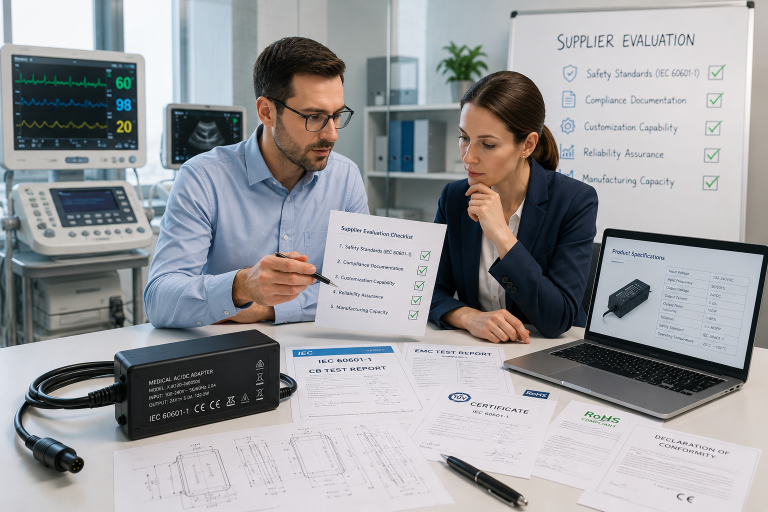
Can They Provide Complete Compliance Documentation?
Receiving a compliant power supply is only part of the procurement process. Equally important is receiving complete and accurate documentation that supports your product certification, quality system, and regulatory submissions.
Many project delays occur because suppliers cannot provide the required documents promptly, or the documents are incomplete, expired, or inconsistent with the actual product being shipped.
Before selecting a supplier, ask exactly which compliance documents will be available for your project. A professional medical power supply manufacturer should be prepared to provide the necessary documentation without repeated follow-up.
Typical documents may include:
Document
Why It Matters
IEC 60601-1 CB Test Report
Demonstrates compliance with medical safety requirements
Beyond the documents themselves, it’s also important to confirm that the reports correspond to the exact model you intend to purchase. In some cases, suppliers may provide certificates for a different power rating or an earlier hardware revision, which can create unnecessary issues during regulatory review.
You should also ask how the supplier manages engineering changes. If components are replaced or the design is updated, will you receive a Product Change Notification (PCN)? Will revised compliance documents be provided automatically? These questions become especially important for medical devices with long production lifecycles.
A supplier that maintains complete, up-to-date documentation demonstrates not only regulatory compliance but also a mature quality management process that can support your project over the long term.
Questions to ask your supplier
Can you provide the CB Test Report and Certificate?
Are the EMC reports available for this exact model?
Do the reports match the current hardware revision?
How do you manage product changes (PCN)?
Can you provide updated compliance documents when the design changes?
Can the Supplier Support Customization?
Very few medical devices use an off-the-shelf power supply without any modifications. Even if the electrical specifications are similar, differences in connectors, cable lengths, labels, or mechanical dimensions often require some level of customization.
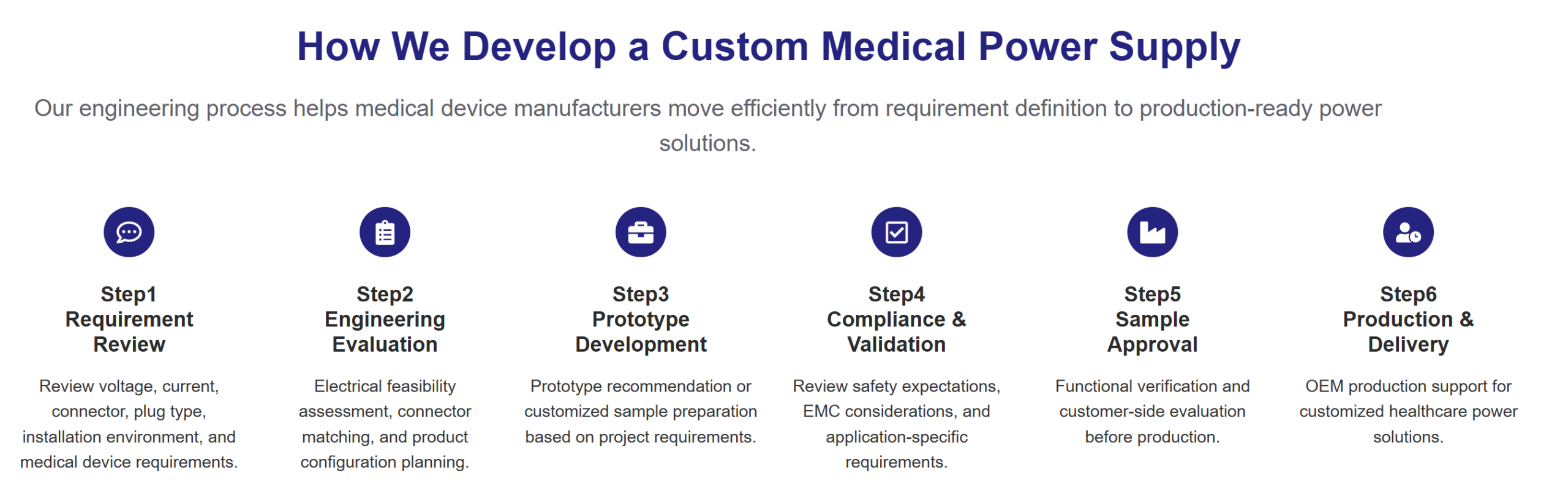
That’s why it’s important to understand a supplier’s engineering capabilities before making a decision.
A reliable medical power supply supplier should be able to support customization without compromising safety certifications or product reliability. Whether you need a different DC connector, a longer cable, a custom enclosure color, or a modified output voltage, the supplier should have a clear engineering process for evaluating and validating the changes.
It’s also worth asking how much customization can be completed without triggering a new certification cycle. Experienced suppliers can often recommend solutions that meet your design requirements while minimizing additional testing and approval costs.
As your product evolves, your power supply requirements may also change. Working with a supplier that offers ongoing engineering support makes future updates much easier than starting over with a new vendor.
Questions to ask your supplier
Can you customize output voltage or current?
Can the DC connector and cable length be modified?
Do custom versions remain compliant with IEC 60601-1?
How do you validate design changes before production?
Can you support future revisions as our product evolves?
How Do They Ensure Long-Term Reliability?
Medical devices are often expected to operate continuously for years, sometimes in environments where failure simply isn’t an option. A power supply may look identical on the outside, but long-term reliability depends on much more than appearance.
When evaluating a supplier, don’t stop at asking for an MTBF number. Instead, ask how that number was obtained.
Some manufacturers calculate MTBF using prediction models, while others perform additional reliability testing such as burn-in, high-temperature operation, or accelerated life testing. Understanding the testing methodology provides much more confidence than comparing specifications alone.
It’s also useful to ask about the supplier’s quality control process. Do they perform 100% functional testing? Is every unit subjected to burn-in before shipment? How are failures analyzed and corrected if they occur during production?
A supplier that openly discusses its reliability process is usually far more trustworthy than one that simply advertises an impressive MTBF figure without supporting data.
What reliability tests are conducted before shipment?
Can you provide reliability or life test reports?
How do you investigate and prevent recurring failures?
Real-world testing and deployment of the custom 120W power adapter for Meta’s high-performance tablet.Real-world testing and deployment of the custom 120W power adapter for Meta’s high-performance tablet.XJK Power’s automated production line and aging test stations ensure consistent power supply quality
Can They Scale with Your Production?
Finding a supplier that can deliver engineering samples is relatively easy. Finding one that can consistently support your product throughout its entire lifecycle is much more challenging.
Medical devices typically remain in production for many years, and a power supply supplier needs to do more than manufacture products. They also need to provide stable component sourcing, consistent quality, and dependable delivery over the long term.
Before choosing a supplier, ask about their production capacity, lead times, and change management process. If a key component becomes obsolete, how will they notify you? Can they provide advance notice before design changes? Do they maintain traceability for every production batch?
These questions may not seem urgent during the prototype stage, but they become critical once your device enters mass production.
1. What certifications should a medical power supply supplier provide?
A qualified supplier should be able to provide documentation such as IEC 60601-1 CB reports and certificates, EMC test reports, RoHS and REACH declarations, product specifications, and declarations of conformity where applicable. Depending on your target market, additional documentation may also be required.
2. Is IEC 60601-1 certification enough when selecting a supplier?
Not necessarily. Certification is only one part of the evaluation process. You should also consider the supplier’s engineering expertise, customization capability, quality control process, long-term reliability, and production capacity.
3. Can a medical power supply be customized without losing compliance?
In many cases, yes. Changes such as output voltage, cable length, connectors, or labeling may be possible while maintaining compliance, but this depends on the scope of the modification. An experienced supplier should be able to explain which changes require additional testing or certification.
4. Why is MTBF important for medical power supplies?
MTBF provides an estimate of product reliability over time. While it shouldn’t be the only factor in supplier selection, understanding how MTBF is calculated and whether it is supported by reliability testing can help assess long-term performance.
5. What should I ask before choosing a medical power supply supplier?
Some of the most important questions include:
Does the supplier understand IEC 60601-1 requirements?
Can they provide complete compliance documentation?
Do they support OEM customization?
How do they validate product reliability?
Can they support long-term production and supply?
Looking for a Reliable Medical Power Supply Supplier?
Selecting the right power supply supplier isn’t just about comparing prices—it’s about finding a partner who understands medical safety standards, supports your engineering team, and can grow with your production needs.
At XJK, we work with medical device manufacturers worldwide to provide IEC 60601-1 compliant power supplies, OEM/ODM customization, and responsive engineering support throughout the product lifecycle.
Whether you’re developing a new medical device or evaluating a second-source supplier, we’re happy to review your requirements and recommend the most suitable solution.
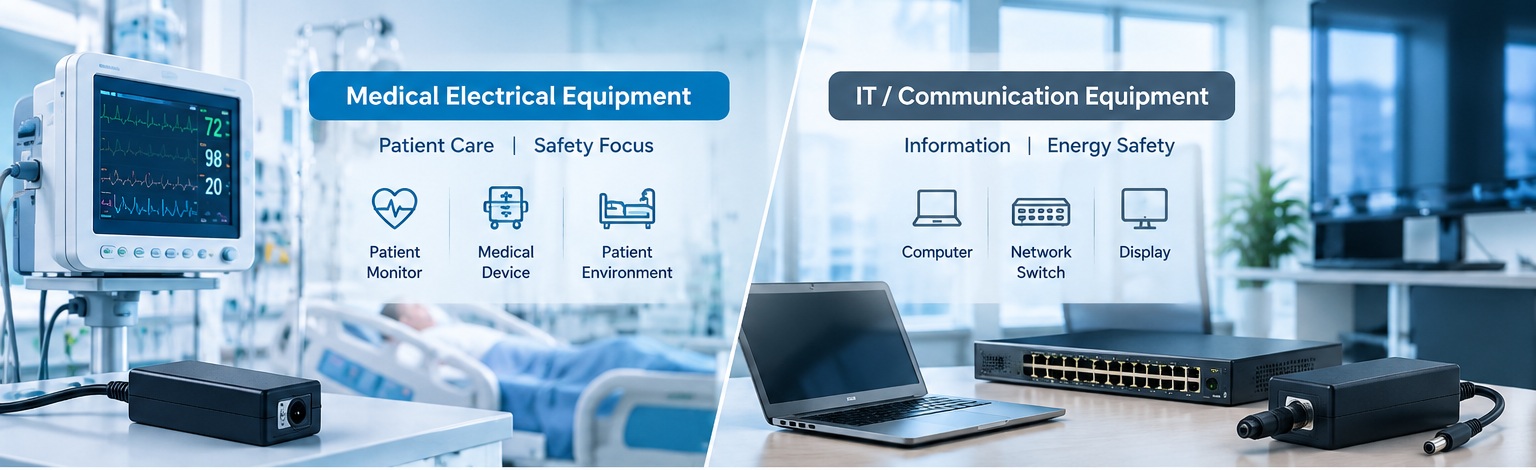
IEC 60601-1 and IEC 62368-1 follow different safety principles and apply to different equipment. This guide explains how intended use, patient protection, isolation, and leakage current affect standard selection and power supply requirements.
A medical equipment OEM needed a reliable power solution for a specialized diagnostic ultrasound system. XJK POWER provided a customized medical AC-DC power solution designed around the equipment’s safety, electrical and integration requirements.
Compact multi-parameter patient monitors are used for short-term and routine monitoring of patients in hospital wards, post-surgical recovery areas, outpatient settings, and other clinical environments. These systems typically monitor ECG, SpO₂, non-invasive blood pressure, respiration, temperature, and pulse rate in a single compact unit.