
Introduction
When selecting AC/DC power supplies for industrial, medical, or commercial applications, customers often require reliability specifications such as 50,000 hours, 100,000 hours, or higher MTBF values.
However, one common question among engineers and purchasing teams is:
Should MTBF be calculated based on component reliability data, or should it be verified through actual reliability testing?
Although both methods provide MTBF results, they represent two different approaches to reliability evaluation.
- MTBF Calculation predicts reliability based on component failure rates and mathematical models.
- MTBF Testing verifies reliability through actual product operation under controlled conditions.
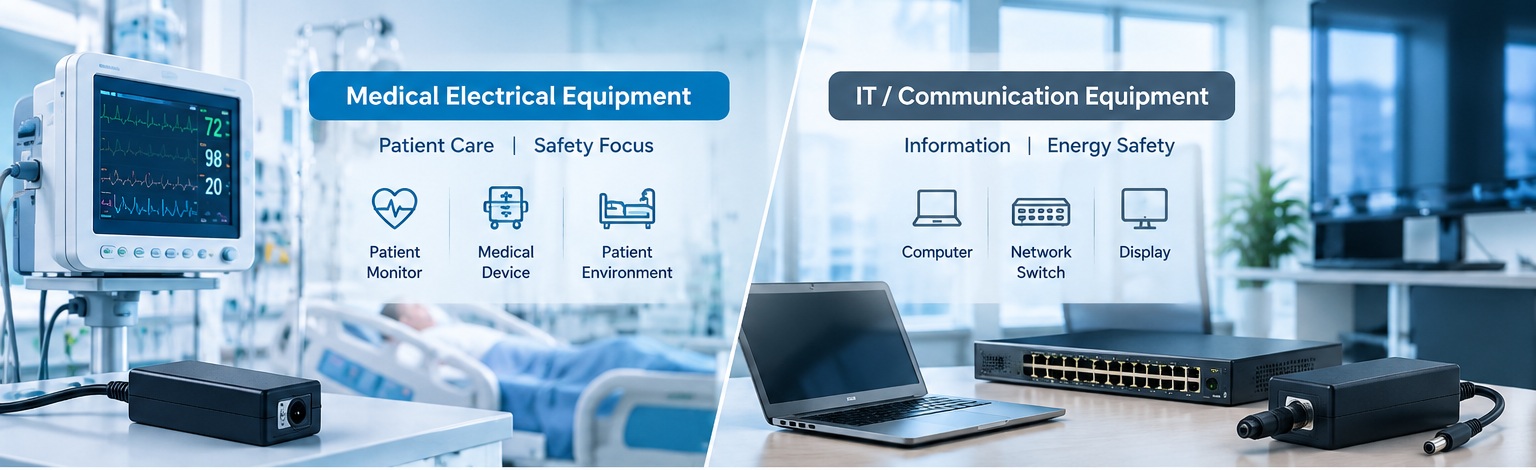
Understanding the difference helps OEM engineers select the appropriate reliability evaluation method for their applications, especially in industries where reliability is critical, such as medical equipment, industrial automation, and networking systems.
This article explains the principles, advantages, limitations, and application scenarios of MTBF calculation and MTBF testing for power supply products.
1. What Is MTBF?
MTBF stands for Mean Time Between Failures.
It is a reliability metric used to estimate the average operating time between failures of a repairable product or system.
The basic formula is:
MTBF = Total Operating Time ÷ Number of Failures
For example:
If 10 power adapters operate for a total of 100,000 hours and experience 2 failures:
MTBF = 100,000 ÷ 2 = 50,000 hours
This means the expected average operating time between failures is 50,000 hours.
However, MTBF does not mean that a product is guaranteed to operate continuously for that exact period.
A power adapter with an MTBF of 100,000 hours does not mean it will fail after 100,000 hours. Instead, it is a statistical reliability indicator used to describe the expected failure rate under specific operating conditions.
MTBF Depends on Test Conditions
An MTBF value is only meaningful when the operating conditions are clearly defined.
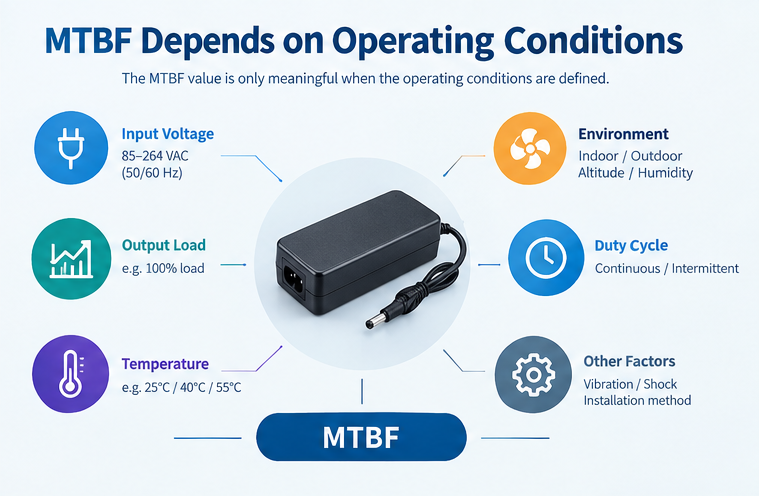
Typical conditions include:
| Parameter | Example |
|---|---|
| Input Voltage | 100-240VAC |
| Output Power | 120W |
| Load Condition | 100% Load |
| Operating Temperature | 25°C / 40°C / 55°C |
| Duty Cycle | Continuous Operation |
| Environment | Ground Fixed Equipment |
For example:
A 120W AC/DC power adapter with an MTBF of 100,000 hours at 25°C may have a significantly different reliability performance compared with the same product tested at 55°C.
Therefore, professional reliability reports should always specify the calculation method or test conditions.
2. What Is MTBF Calculation?
MTBF Calculation (MTBF Prediction)
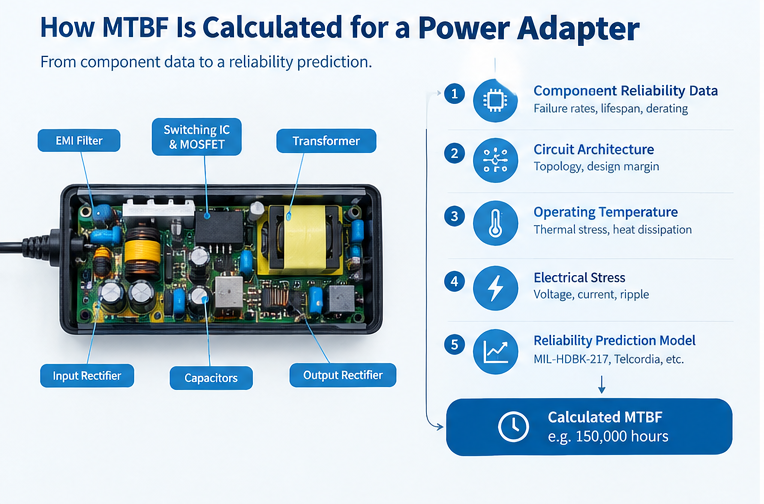
MTBF calculation, also called MTBF prediction, estimates product reliability by analyzing the failure rates of individual components.
Instead of running the product for thousands of hours, engineers calculate the expected reliability based on:
- Component failure rate data
- Circuit design
- Operating temperature
- Electrical stress
- Environmental conditions
The final MTBF value is a predicted reliability indicator.
Common MTBF Prediction Methods
1. MIL-HDBK-217
MIL-HDBK-217 is one of the most widely known reliability prediction standards.
It was originally developed for military electronic equipment.
The method calculates reliability based on:
- Component type
- Component quantity
- Operating environment
- Temperature stress
- Electrical stress
Advantages:
- Long history of application
- Widely recognized
- Suitable for high-reliability electronic systems
Limitations:
- Results can be conservative
- Component failure databases may not represent modern components
2. Telcordia SR-332
Telcordia SR-332 is commonly used in telecommunications and networking industries.
It considers:
- Component reliability data
- Field failure information
- Operating environment
Applications include:
- Communication equipment
- Network devices
- Industrial communication systems
3. IEC TR 62380
IEC TR 62380 provides reliability prediction methods based on:
- Component failure rates
- Temperature conditions
- Operating cycles
- Environmental factors
It is commonly used for industrial electronic products.
Example of MTBF Calculation for a Power Adapter
A 120W AC/DC power adapter may contain:
| Component | Quantity |
|---|---|
| Power IC | 1 |
| MOSFET | 2 |
| Electrolytic Capacitor | 6 |
| Ceramic Capacitor | Several |
| Transformer | 1 |
| Rectifier Diodes | Multiple |
Each component has an estimated failure rate.
By combining the failure rates of all components, engineers can calculate the overall reliability.
For example:
Calculated MTBF:
150,000 hours at 25°C
However, this value represents:
Predicted reliability based on component data and calculation models.
It does not represent actual field-tested performance.
3. What Is MTBF Testing?
Actual Reliability Verification Through Testing
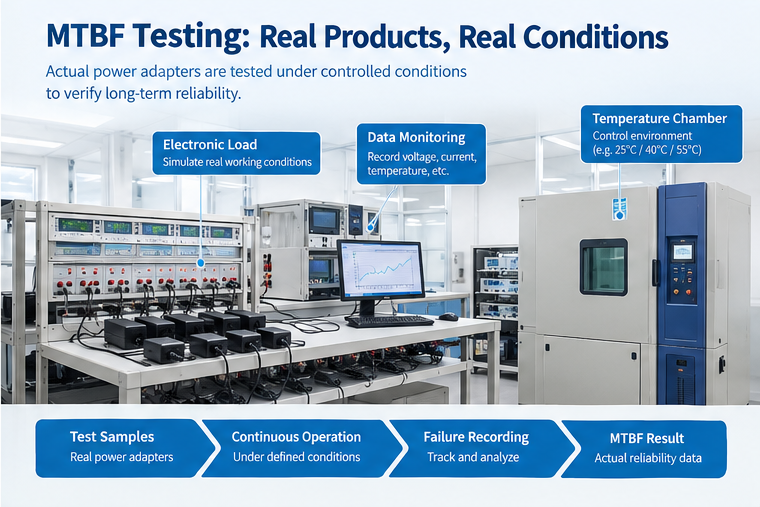
MTBF testing evaluates reliability by operating real products under controlled conditions and monitoring failures.
Unlike calculation methods, MTBF testing requires:
- Actual product samples
- Test equipment
- Environmental control
- Long-term operation
- Failure recording
The purpose is to verify whether the actual product performance meets reliability expectations.
Typical MTBF Testing Conditions for Power Supplies
A reliability test may include:
| Test Item | Example Condition |
|---|---|
| Sample Quantity | 30 units |
| Temperature | 55°C |
| Load | 90%-100% Rated Load |
| Input Voltage | Rated Input |
| Operation Mode | Continuous Operation |
| Test Duration | 30 Days |
| Failure Criteria | Zero Failure |
After testing, statistical analysis is used to calculate the estimated MTBF value.
Accelerated MTBF Testing (DMTBF)
For power supply products, traditional MTBF testing can require extremely long periods.
Therefore, manufacturers often use:
Demonstration MTBF Testing (DMTBF)
or accelerated reliability testing.
DMTBF testing increases the stress level by controlling conditions such as:
- Higher ambient temperature
- Continuous operation
- Power cycling
- High load operation
The collected data is then analyzed using reliability models to estimate product performance under normal conditions.
DMTBF is commonly requested for:
- Medical power supplies
- Industrial control systems
- Mission-critical equipment
Learn More about DMTBF VS MTBF.
4. MTBF Calculation vs MTBF Testing: Key Differences
| Comparison | MTBF Calculation | MTBF Testing |
|---|---|---|
| Method | Mathematical prediction | Physical verification |
| Data Source | Component reliability database | Actual product operation |
| Product Samples | Not required | Required |
| Testing Time | Short | Long |
| Cost | Lower | Higher |
| Reliability Evidence | Predicted | Verified |
| Design Stage | Early development | Prototype / Mass Production |
| Failure Detection | No actual failures | Real failure monitoring |
| Accuracy | Depends on model data | More representative of real products |
5. Which Method Is More Accurate?
It is not correct to simply say that one method is always better.
The two approaches serve different purposes.
Advantages of MTBF Calculation
MTBF prediction is useful during product development because it provides:
Faster Reliability Evaluation
Engineers can estimate reliability before mass production.
Design Optimization
If a component has a high predicted failure rate, engineers can:
- Select higher-quality components
- Reduce electrical stress
- Improve thermal design
Lower Cost
No long-term reliability testing is required.
Limitations of MTBF Calculation
However, calculation methods also have limitations:
Based on Assumptions
The result depends on:
- Database accuracy
- Model selection
- Operating assumptions
Cannot Fully Reflect Manufacturing Variation
Calculation cannot detect issues caused by:
- Production processes
- Assembly quality
- Component variation
Does Not Simulate Real Operation
Actual environmental conditions may differ from assumptions.
Advantages of MTBF Testing
MTBF testing provides direct reliability verification.
Benefits include:
Real Product Performance Data
Testing evaluates the actual finished product.
Detects Potential Design Issues
Testing may reveal:
- Thermal problems
- Component failures
- Weak design points
Stronger Evidence for Critical Applications
For medical and industrial customers, actual reliability testing can provide stronger confidence.
Limitations of MTBF Testing
However:
Higher Cost
Requires:
- Multiple samples
- Test equipment
- Laboratory resources
Longer Time
Reliability tests may require weeks or months.
6. Should OEM Customers Require MTBF Calculation or Testing?
The correct choice depends on the application requirements.
Industrial Power Supply Applications
For many industrial applications, MTBF calculation is commonly accepted.
Examples:
- Industrial controllers
- Networking equipment
- Automation systems
- LED displays
- Security systems
A reliability prediction report combined with standard quality control processes is often sufficient.
Medical Power Supply Applications
Medical equipment requires a higher level of reliability because failures may affect patient safety.
Typical requirements may include:
- MTBF prediction report
- Reliability test data
- DMTBF test report
- Safety compliance with IEC 60601-1
Applications include:
- Patient monitors
- Medical imaging equipment
- Diagnostic devices
- Portable medical equipment
For these applications, customers may request additional reliability validation beyond standard MTBF calculation.
Safety-Critical Equipment
For systems where reliability is extremely important, actual testing is strongly recommended.
Examples:
- Critical monitoring equipment
- Long-duration medical systems
- Industrial systems operating continuously
Combining MTBF calculation and testing provides the most comprehensive reliability evaluation.
7. How Power Supply Manufacturers Provide MTBF Information
A professional power supply manufacturer should provide reliability information based on clear methods and conditions.
Typical reliability documentation includes:
1. MTBF Prediction Report
Including:
- Calculation standard
- Component reliability data
- Operating conditions
- Estimated MTBF value
2. Reliability Test Report
Including:
- Sample quantity
- Test temperature
- Load condition
- Test duration
- Failure records
3. Product Validation Data
Additional verification may include:
- Burn-in testing
- Temperature rise testing
- Protection function testing
- Life testing
These tests help ensure stable performance during actual customer applications.
8. Common Misunderstandings About MTBF
Q1: Does 100,000 Hours MTBF Mean the Product Lasts 100,000 Hours?
No.
MTBF is a statistical reliability measurement, not a guaranteed operating lifetime.
Actual product lifetime depends on:
- Component aging
- Operating environment
- Temperature
- Load condition
Q2: Is Calculated MTBF Accepted by Customers?
It depends on the industry.
For many industrial applications, MTBF prediction is widely accepted.
For medical and safety-critical applications, customers may require additional reliability testing.
Q3: Is Higher MTBF Always Better?
Not necessarily.
The test conditions are equally important.
For example:
- 100,000 hours MTBF at 25°C
- 100,000 hours MTBF at 55°C
represent very different reliability levels.
Q4: Can MTBF Testing Replace MTBF Calculation?
Not always.
Calculation is useful during design evaluation, while testing validates actual performance.
Many professional manufacturers use both methods together.
Conclusion
MTBF calculation and MTBF testing are two different approaches to evaluating product reliability.
MTBF calculation provides a fast reliability prediction based on component data and mathematical models, making it suitable for early design evaluation and many industrial applications.
MTBF testing verifies actual product reliability through real operation and is more suitable for applications requiring stronger reliability evidence, such as medical equipment and critical industrial systems.
For OEM customers selecting AC/DC power adapters, understanding the difference between predicted reliability and tested reliability helps ensure the right validation method is selected for the application.