Case Study: 12V 5A Power Adapter for Multi-Door Access Control Systems

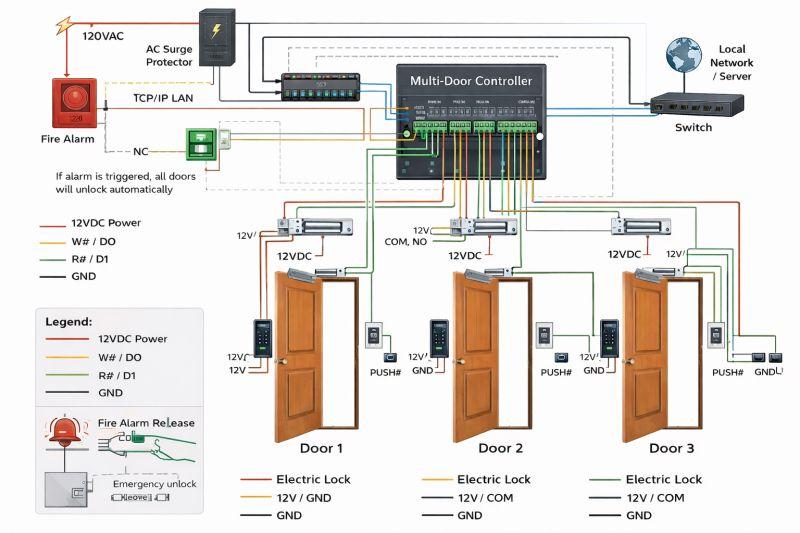
Multi-door access control systems rely on stable DC power to operate access controllers, card readers, and communication modules. As the number of connected devices increases, power designers must consider not only the total load but also startup current, voltage drop, and the operating conditions of the installation.

This case study examines the engineering considerations involved in selecting a 12V 5A (60W) AC/DC power adapter for a multi-door access control application, with a focus on load budgeting, power distribution, and system integration.

Project Overview

The application involves evaluating a 12V 5A power adapter for a multi-door access control system in which multiple electronic devices share a DC power source or a coordinated power distribution architecture.

The objective is to assess whether a 60W AC/DC power adapter can meet the system’s power requirements while supporting reliable operation and practical installation.

The 12V 5A power adapter is evaluated as a potential power source for compatible access control equipment. Before implementation, the engineering team must verify the total connected load and determine whether the proposed configuration provides sufficient operating margin.

The final configuration should also account for the distinction between control electronics and high-current devices, such as certain types of electric locks. Depending on the system architecture, these loads may require separate power supplies or a dedicated access control power distribution unit.

Project Parameter Description
Application Multi-Door Access Control Systems
Power Solution AC/DC Power Adapter
Rated Output Voltage 12V DC
Rated Output Current 5A
Rated Output Power 60W
Input Voltage According to the selected adapter specification
Typical Connected Equipment Access controllers, card readers, communication modules
Main Design Considerations Power budget, startup current, voltage drop, and load distribution
Integration Requirements Output connector, cable configuration, and installation compatibility
Customization Options Subject to product platform and project requirements


Typical Power Architecture

Customer Challenge

For multi-door access control applications, the main challenge is not simply selecting a power adapter with the correct output voltage. Engineers must ensure that the power source can support the connected devices under normal operating conditions and during periods of increased demand.

1. Supplying Multiple Devices from One Power Source

A multi-door access control system may include several access controllers, card readers, communication interfaces, and auxiliary electronic modules.

Each device contributes to the overall power demand. If the total load approaches the adapter’s rated output, simultaneous operation or unexpected load changes may cause the power supply to reach its current limit.

An undersized power source may lead to voltage instability, unexpected device resets, or intermittent operation, depending on the characteristics of the connected equipment and the adapter’s protection behavior.

The engineering challenge is to calculate the actual load and determine whether a 12V 5A power adapter can provide sufficient capacity for the intended configuration.

2. Maintaining Stable Voltage Across Multiple Door Locations

In installations where equipment is distributed across several doors, the distance between the power source and individual devices can vary significantly.

Cable resistance, conductor size, connector resistance, and load current all affect the voltage delivered to each device. Even when the power adapter maintains a stable 12V output at its terminals, the voltage at a remote card reader or controller may be lower.

If the voltage falls outside the connected device’s permitted input range, the device may experience unstable operation or fail to function as expected.

A suitable power distribution and wiring strategy is therefore essential for maintaining adequate voltage at each connected device.

3. Meeting Reliability and Integration Requirements

Access control equipment is often expected to operate consistently over extended periods. The power supply must therefore be compatible with the installation environment, electrical load, and equipment interface requirements.

Engineers may also need to consider short-circuit protection, overload behavior, operating temperature, cable assemblies, and mechanical integration.

For installations requiring backup power, the design must additionally account for battery charging, power transfer during an AC outage, and any required monitoring functions. These capabilities cannot be assumed to be available in a standard AC/DC adapter.

The challenge is to identify a power solution that meets the electrical requirements while remaining practical for the equipment manufacturer’s integration and production needs.

XJK Engineering Solution

To address these challenges, the power supply selection process should begin with load evaluation and continue through power distribution design, electrical compatibility checks, and system-level verification.

A 12V 5A AC/DC power adapter provides a maximum rated output power of 60W:

Output Power = Output Voltage × Output Current

12V × 5A = 60W

The first step is to determine the power consumption of every device supplied by the adapter.

For equipment operating at the same 12V DC input voltage, the total current can be calculated by adding the current requirements of the connected devices. The corresponding total power can then be calculated using the 12V output voltage.

For example, if the combined continuous load is 3.5A, the corresponding output power is:

12V × 3.5A = 42W

This represents 70% of the adapter’s 60W rated output. However, the remaining nominal capacity should not automatically be treated as sufficient design margin. Engineers must also consider startup current, transient loads, temperature-related derating, and the adapter manufacturer’s operating specifications.

If the calculated load exceeds the acceptable operating capacity, a higher-capacity power supply or a revised power distribution architecture should be considered.

How We Develop a Custom Power Supply

Our engineering process helps  device manufacturers move efficiently from requirement definition to production-ready power solutions.

Step1
Requirement
Review

Review voltage, current, connector, plug type, installation environment, and medical device requirements.

Step2
Engineering
Evaluation

Electrical feasibility assessment, connector matching, and product configuration planning.

Step3
Prototype
Development

Prototype recommendation or customized sample preparation based on project requirements.

Step4
Compliance &
Validation

Review safety expectations, EMC considerations, and application-specific requirements.

Step5
Sample
Approval

Functional verification and customer-side evaluation before production.

Step6
Production &
Delivery

OEM production support for customized healthcare power solutions.

Technical Design Considerations

Selecting a 12V 5A power adapter requires more than matching the rated voltage and current. The following engineering factors should be evaluated before the power solution is finalized.

1. Power Budget and Operating Margin

2. Startup Current and Transient Loads

3. Cable Resistance and Voltage Drop

Cable voltage drop is an important consideration when supplying devices located at multiple doors.

For a simple two-conductor DC circuit, the approximate voltage drop can be expressed as:

Voltage Drop = Current × Total Loop Resistance

The total loop resistance includes both the outgoing and return conductors, as well as relevant connection resistance.

4. Protection, Backup Power, and System Integration

Project Result

The engineering evaluation of a 12V 5A power adapter for a multi-door access control system provides a structured approach to matching the power source with the connected equipment.

When the load calculation, wiring design, electrical protection, and system interfaces are properly verified, the resulting power solution can offer several practical benefits.

Considering startup current, protection behavior, operating temperature, and backup power requirements helps ensure that the selected power solution is evaluated against the actual demands of the application.

Final selection should be based on verified electrical specifications and system-level testing. A 12V 5A adapter is a suitable candidate only when its rated output and operating characteristics meet the requirements of the complete connected load.

For this application scenario, the key engineering outcome is a more systematic method for evaluating a 60W power adapter and determining whether it is appropriate for a specific multi-door access control configuration.

Recommended Products

12V 5A Power Adapter

12V DC power source with an output current of up to 5A. With a rated output power of 60W, it provides an external power solution for compatible equipment used in industrial control, electronic systems, communication applications, and other commercial equipment.

FAQ

Q1: Is a 12V 5A power adapter suitable for a multi-door access control system?

A 12V 5A power adapter provides up to 60W of rated output power. It may be suitable for a multi-door access control system when the combined load remains within the adapter’s acceptable operating capacity and all connected devices meet its electrical requirements.

The final selection should account for continuous power consumption, startup current, cable voltage drop, ambient temperature, and any applicable derating requirements.

Q2: How do I calculate the power requirements of a multi-door access control system?

Start by identifying every device supplied by the same power source, including access controllers, card readers, communication modules, and any other connected loads.

Calculate the total expected power consumption and determine which devices may operate simultaneously. Then compare the resulting load profile with the power supply’s rated output, taking startup current and operating conditions into account.

For a 12V system, total power can be calculated by multiplying the output voltage by the combined current when all relevant loads operate at 12V.

Q3: Can one 12V 5A power adapter supply both access controllers and electric door locks?

This depends on the lock type, controller configuration, total current demand, and system wiring.

Some electric locks draw substantial current during activation or have operating requirements that differ from those of access controllers and card readers. In such cases, separate power supplies or a dedicated access control power distribution unit may be more appropriate.

The complete load must be evaluated before deciding whether a single 60W adapter can supply all connected equipment.

Q4: What causes voltage drop in a multi-door access control system?

Voltage drop is primarily affected by cable length, conductor resistance, current demand, and connection resistance.

Longer cable runs and higher current generally produce greater voltage drop. Using appropriately sized conductors, minimizing unnecessary connection resistance, and optimizing power distribution can help maintain the required voltage at remote devices.

The actual voltage should be verified at the device under representative operating conditions.

Q5: Can a 12V 5A power adapter provide backup power for an access control system?

A standard AC/DC power adapter does not automatically provide battery backup.

If the access control system must remain operational during a mains power failure, a compatible battery-backed power arrangement may be required. Battery charging, power transfer, monitoring, and protection must be addressed according to the system requirements.

The selected architecture should be confirmed before installation to ensure that the required backup functions are supported.


Looking for a 12V 5A Power Adapter for Your Access Control System?

Selecting the right power adapter requires more than matching the output voltage and current. The total load, cable configuration, electrical protection, and equipment interfaces must all be considered to achieve a suitable power solution.

XJK Power supports power supply selection and OEM/ODM customization discussions for equipment manufacturers and system integrators, subject to the available product platform and project requirements.

Whether you are developing a multi-door access control system or integrating a 12V power source into an existing design, our team can work with you to evaluate the required output specifications, connectors, cable assemblies, and mechanical configuration.

Related Resources

Request a Quote

Leave your requirements and we’ll get back to you within 24 hours.