Understanding IEC 60601-1 patient protection requirements and how to select a compliant medical power supply
Introduction
Selecting a medical power supply is not simply a matter of matching output voltage, current, and power rating. For medical device manufacturers, the safety classification of the power supply can directly affect whether the final product meets IEC 60601-1 requirements.
One of the most commonly misunderstood concepts in medical power design is 2×MOPP (Two Means of Patient Protection). Many engineers understand that medical equipment requires higher isolation, but questions often remain:
- Does 2×MOPP mean the power supply must be Class II?
- Is grounding required for a medical power adapter?
- When is 1×MOPP sufficient, and when is 2×MOPP necessary?
- How can engineers verify whether a medical power supply truly meets patient protection requirements?
In IEC 60601-1, MOPP defines the level of protection provided to patients against electric shock. Compared with industrial power supplies, medical power supplies require stricter requirements for isolation, leakage current, creepage distance, and safety testing.
This article explains what 2×MOPP means, how it differs from Class I and Class II protection, and what medical device engineers should consider when selecting a compliant medical power supply.
1. Why Do Medical Power Supplies Need 2×MOPP?
1.1 Patients Have Higher Safety Risks
Medical devices are different from normal electronic products.
Patients may be:
- Connected through ECG electrodes
- Connected through probes or sensors
- Physically unable to respond
- In direct contact with conductive parts
Therefore, IEC 60601-1 requires higher protection levels.
1.2 Protection Under Single Fault Conditions
Medical equipment must remain safe even when one protection layer fails.
For example:
Normal operation:
Single fault:
This redundancy is the reason why 2×MOPP is used in higher-risk medical applications.
2. What Is MOPP in IEC 60601-1?
MOPP stands for Means of Patient Protection.
It refers to the protective measures used to reduce the risk of electric shock to patients in medical electrical equipment.
According to IEC 60601-1, medical devices must maintain safety even under single fault conditions, meaning the equipment must remain safe even if one protective measure fails.
For example:
- Insulation damage occurs
- A component fails
- A safety barrier is compromised
The remaining protection must still prevent dangerous current from reaching the patient.
MOPP vs MOOP: What Is the Difference?
Many engineers confuse MOPP with MOOP.
Although they have similar concepts, the protection targets are different.
| MOOP | MOPP | |
|---|---|---|
| Full Name | Means of Operator Protection | Means of Patient Protection |
| Protection Target | Equipment operator | Patient |
| Application | Industrial equipment, laboratory devices | Medical equipment |
| Safety Requirement | Lower | Higher |
| Leakage Current Limit | Higher | Lower |
The reason MOPP requirements are stricter is that patients may be physically connected to medical equipment and may not be able to move away from a hazardous condition.
3. 2×MOPP vs 1×MOPP: Understanding Patient Protection Levels
The number before MOPP indicates the number of independent protective measures between the hazardous voltage source and the patient.
1×MOPP
1×MOPP means one level of patient protection.
A single protective barrier is provided between the dangerous voltage and patient-accessible parts.
2×MOPP
2×MOPP means two independent levels of patient protection.
There are two separate protective barriers to prevent hazardous voltage from reaching the patient.
If one insulation barrier fails, the second protection layer continues to provide safety.
4. 2×MOPP Is Not the Same as Class I or Class II Protection
When selecting a medical power supply, engineers often confuse MOPP requirements with Class I and Class II equipment classification.
Although both concepts are related to electrical safety, they describe different aspects of protection.
- Class I / Class II defines how the equipment protects users from electric shock, mainly through grounding or insulation methods.
- MOPP (Means of Patient Protection) defines the level of protection provided specifically for patients according to IEC 60601-1.
In other words:
Class classification answers: “How is the equipment protected from electric shock?”
MOPP answers: “How well is the patient protected from electrical hazards?”
Class I Medical Equipment: Protection Through Protective Earth
Class I equipment relies on two safety measures:
- Basic insulation
- Protective earth (PE) connection
A typical Class I structure:
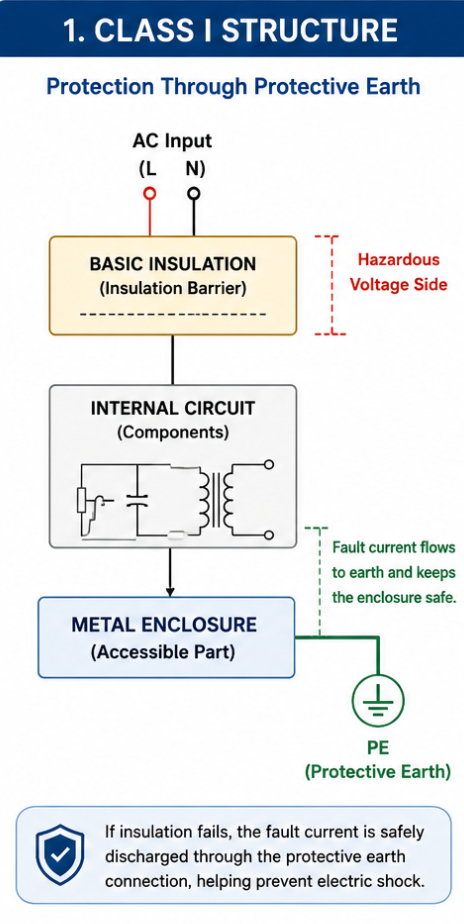
If insulation fails and a conductive enclosure becomes energized, the fault current is safely discharged through the earth connection, helping prevent electric shock.
Typical Class I medical equipment includes:
- Large diagnostic systems
- Medical devices with metal housings
- Equipment designed for fixed installations
However, Class I equipment requires a reliable grounding connection, which may not always be practical for portable medical devices.
Class II Medical Equipment: Protection Without Grounding
Class II equipment does not rely on protective earth.
Instead, safety is achieved through:
- Double insulation
- Reinforced insulation
Typical structure:
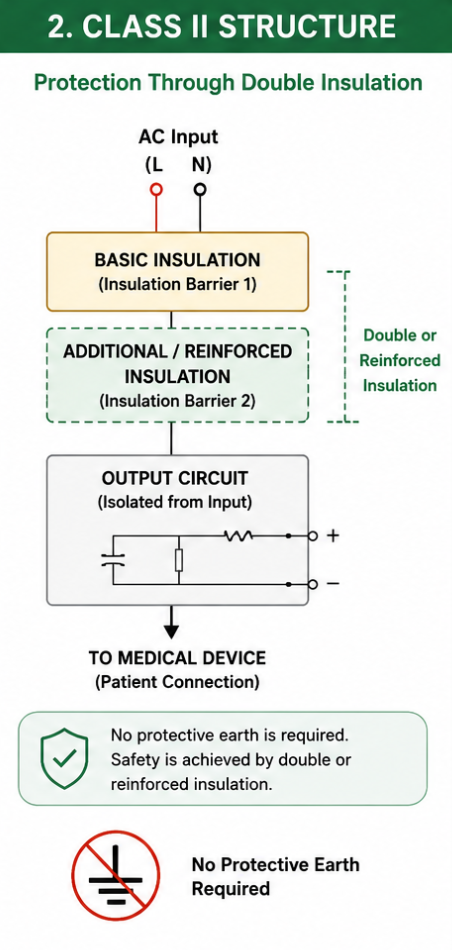
Because no grounding connection is required, Class II designs are commonly used for:
- Portable medical devices
- External medical adapters
- Handheld healthcare equipment
This is why many medical AC/DC adapters use a two-pin input plug instead of a three-pin grounded plug.
Where Does 2×MOPP Fit In?
2×MOPP is a different safety requirement.
It describes the number of independent protection barriers between hazardous voltage and the patient.
For example:
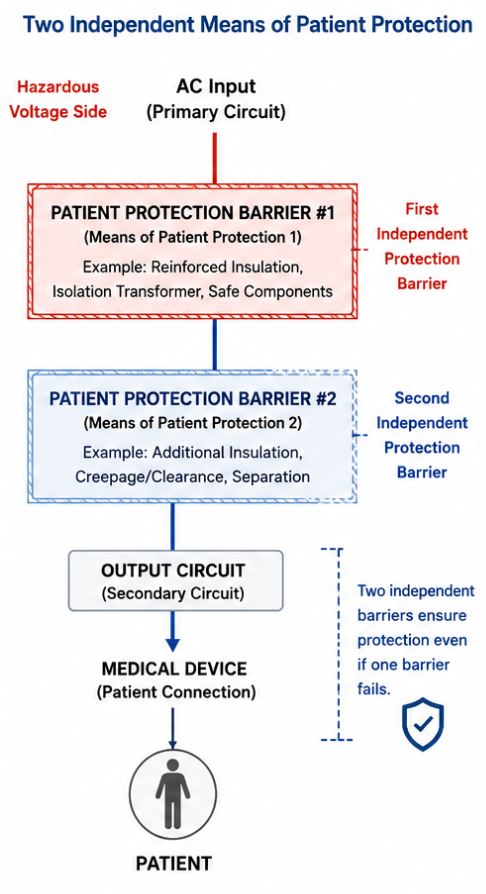
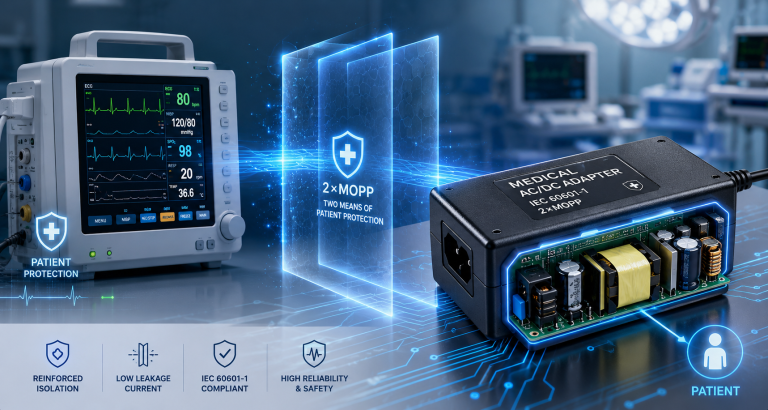
A medical power supply designed for 2×MOPP must provide two independent means of patient protection.
This may be achieved through:
- Reinforced insulation
- Increased creepage and clearance distances
- Medical-grade transformer design
- Controlled leakage current
- Additional safety testing
Can a Power Supply Be Class II and 2×MOPP?
Yes.
In fact, many external medical power adapters are designed as:
Class II + 2×MOPP
For example:
A medical AC/DC adapter may have:
- No protective earth connection
- Double/reinforced insulation
- 2×MOPP patient protection
- Low leakage current
The combination allows portable medical devices to achieve high safety performance without requiring a grounding cable.
Simple Comparison: Class I, Class II, and 2×MOPP
| Concept | Main Question | Protection Method |
|---|---|---|
| Class I | How is electric shock protection achieved? | Basic insulation + protective earth |
| Class II | How is electric shock protection achieved without grounding? | Double/reinforced insulation |
| 1×MOPP | How many patient protection barriers exist? | One means of patient protection |
| 2×MOPP | How many patient protection barriers exist? | Two independent means of patient protection |
Why This Difference Matters for Medical Device Engineers
When selecting a medical power supply, engineers should not only ask:
“Is this power supply Class II?”
or
“Does this adapter have IEC 60601-1 certification?”
Instead, they should verify:
- Is the application patient-connected?
- Does the system require 1×MOPP or 2×MOPP?
- Is the leakage current within required limits?
- Does the power supply certification report specify the correct MOPP classification?
A Class II adapter may be suitable for a portable medical device, but the required MOPP level depends on the patient connection and the final equipment design.
5. Engineering Considerations for Designing a 2×MOPP Medical Power Supply
Achieving 2×MOPP compliance requires more than adding extra insulation to a standard AC/DC adapter.
For medical power supplies, engineers must carefully design the entire safety isolation system, including the transformer structure, PCB layout, insulation materials, leakage current control, and verification testing.
Compared with commercial power adapters, a 2×MOPP medical power supply requires a higher level of protection between the input mains voltage and the patient-accessible output.
The following factors are critical for achieving 2×MOPP compliance.
5.1 Reinforced Insulation and Isolation Barrier Design
The most important element of a 2×MOPP design is the isolation barrier between the primary side and secondary side.
The primary side is connected to hazardous AC mains voltage, while the secondary side may supply a medical device connected to the patient.
A 2×MOPP design requires two independent protection measures.
Typical design methods include:
- Reinforced insulation
- Double insulation structures
- Safety-certified transformer construction
- Additional insulation layers between primary and secondary circuits
The isolation system must remain effective even if one protection layer fails.
5.2 Creepage Distance and Clearance Distance
For medical power supplies, PCB layout is a critical part of achieving 2×MOPP.
Two important parameters are:
Clearance Distance
The shortest distance through air between two conductive parts.
Example:
Primary circuit → Secondary circuit
Creepage Distance
The shortest distance along the surface of an insulating material.
Example:
PCB trace → PCB trace across insulation surface
For higher protection levels such as 2×MOPP, greater creepage and clearance distances are usually required compared with standard commercial adapters.
This often affects:
- Overall adapter design
- PCB size
- Transformer dimensions
- Component placement
5.3 Medical-Grade Transformer Design
The transformer is one of the most critical components in a medical power supply.
A standard transformer used in consumer electronics may not provide sufficient isolation for medical applications.
A 2×MOPP medical transformer typically requires:
- Reinforced insulation between windings
- Safety-approved insulation materials
- Controlled winding arrangement
- Higher dielectric strength capability
For higher power adapters, such as 120W or 180W medical power supplies, transformer design becomes even more challenging because engineers must balance:
- Size limitations
- Safety distance
- Efficiency
- Thermal performance
5.4 Low Leakage Current Design
MLeakage current is another key requirement for medical power supplies.
Even when the isolation barrier is working correctly, small currents may flow through parasitic capacitance between primary and secondary circuits.
Medical equipment has stricter leakage current limits because the output may be connected to a patient.
Design considerations include:
- Optimized EMI filter design
- Selection of safety capacitors
- Transformer construction
- PCB layout optimization
A power supply can pass general electrical safety tests but still fail medical requirements if leakage current is too high.
Choose a reliable medical power supply manufacturer with IEC 60601 experience.
6. When Do Medical Devices Need 2×MOPP?
Not every medical device requires 2×MOPP.
The required protection level depends on the application and patient connection type.
Applications commonly requiring higher patient protection include:
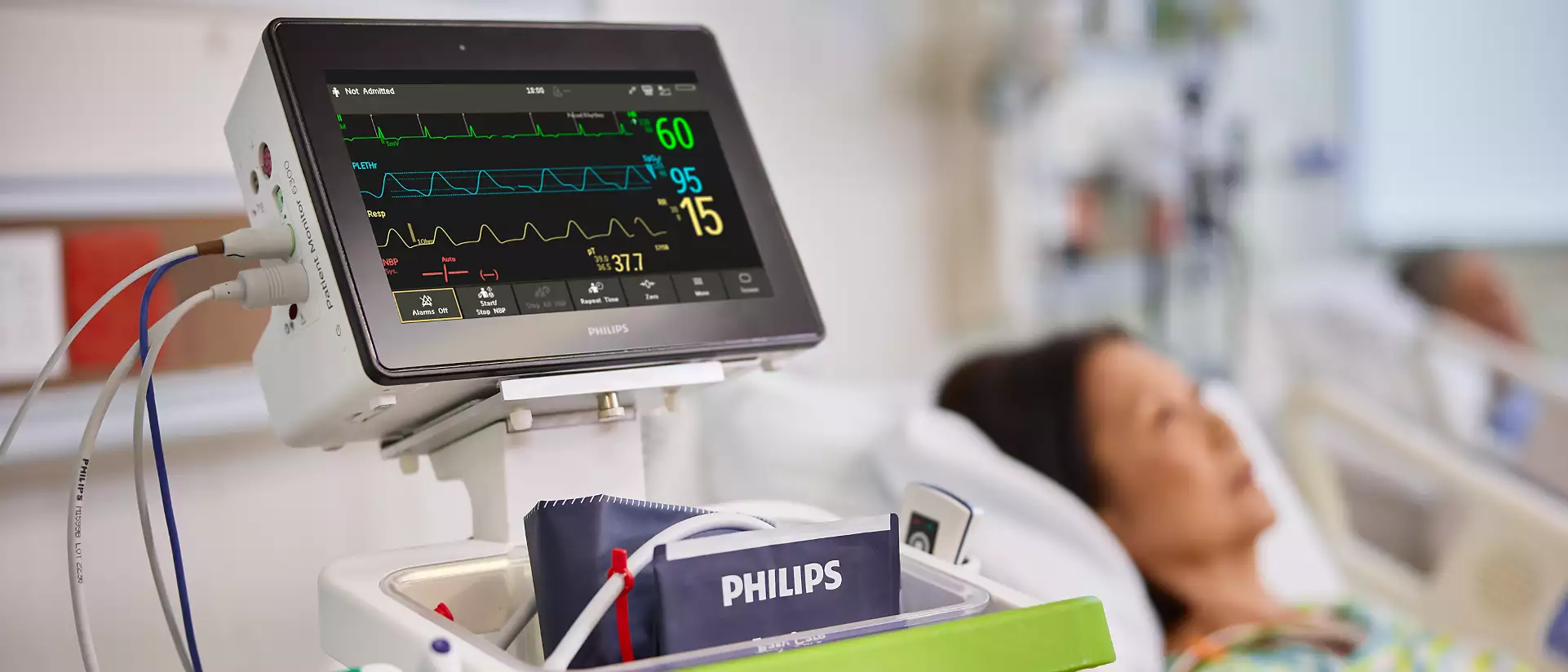
Patient Monitoring Equipment
Examples:
- ECG monitors
- Patient monitors
- Vital sign monitoring systems
Diagnostic Equipment
Examples:
- Ultrasound equipment
- Medical imaging systems
- Diagnostic analyzers
Treatment Equipment
Examples:
- Infusion pumps
- Respiratory equipment
- Portable treatment devices
These applications often require stronger isolation because they may have direct electrical connection with patients.
7. How OEM Engineers Should Evaluate a Medical Power Supply Supplier
When selecting a medical power adapter, engineers should evaluate more than just output specifications.
7.1 Verify IEC 60601-1 Compliance
Check whether the power supply has:
- IEC 60601-1 certification
- CB certification
- Applicable regional approvals
Do not assume every “medical grade” power supply automatically provides 2×MOPP.
7.2 Confirm MOPP Level
Review the safety report and confirm:
- 1×MOPP or 2×MOPP
- MOOP or MOPP classification
- Isolation specifications
7.3 Check Electrical Parameters
Important specifications include:
- Output voltage
- Output current
- Rated power
- Operating temperature
- Continuous operation capability
7.4 Consider the Complete Medical System
A compliant power adapter does not automatically make the final medical device compliant.
Engineers must consider:
- Power supply
- Device enclosure
- Patient connection
- System-level leakage current
IEC 60601-1 compliance is evaluated at the equipment level.
8. Example: 120W 2×MOPP Medical Power Adapter Design
Mistake 1: Assuming IEC 60601-1 Means 2×MOPP
IEC 60601-1 compliance alone does not always mean the power supply provides 2×MOPP.
Engineers should check the specific safety classification.
Mistake 2: Confusing Class II With 2×MOPP
Class II means:
No protective earth grounding is required.
2×MOPP means:
Two levels of patient protection are provided.
They solve different safety problems.
Mistake 3: Using Industrial Power Supplies for Medical Applications
Industrial power supplies may provide:
- Good efficiency
- High reliability
- Low cost
However, they may not meet:
- Patient leakage current limits
- MOPP requirements
- IEC 60601-1 isolation requirements
9. Example: 120W 2×MOPP Medical Power Adapter Solution
For medical devices requiring reliable patient protection, a customized medical power adapter can provide:
Example specification:
120W Medical AC/DC Power Adapter
- Output: 24V DC 5A
- IEC 60601-1 compliant design
- 2×MOPP isolation
- Low leakage current
- Suitable for continuous operation
- Designed for medical equipment manufacturers
Typical applications:
- Medical workstations
- Diagnostic equipment
- Patient monitoring systems
- Portable healthcare devices
For OEM medical device manufacturers, selecting the correct power supply early in the design stage helps reduce certification risks and shorten product development cycles.
Conclusion
2×MOPP is an important safety requirement defined by IEC 60601-1 for medical electrical equipment.
It represents two independent means of patient protection between hazardous voltage and patient-accessible parts.
However, 2×MOPP should not be confused with Class I or Class II equipment classification.
- Class I/Class II defines whether protective grounding is used.
- MOPP defines the level of protection provided to patients.
For medical device engineers, understanding these differences is essential when selecting a compliant medical power supply.
A properly designed Class II medical power adapter with 2×MOPP protection can provide the isolation, low leakage current, and safety performance required for modern patient-connected medical equipment.