Customized Medical AC-DC Power Solution for a Specialized Diagnostic Ultrasound System

A medical equipment manufacturer was developing a specialized diagnostic ultrasound system and needed a reliable external medical power supply that could be integrated into its existing system architecture.

The project required more than simply matching the required voltage and wattage. The power solution needed to balance medical safety, output stability, electrical noise, thermal performance, mechanical integration, and long-term reliability.

XJK POWER worked with the customer to evaluate the system requirements and develop a customized medical AC-DC power solution suitable for the ultrasound equipment’s operating and integration requirements.

Project Overview

Project Overview

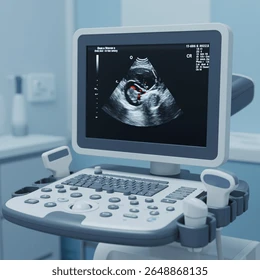
The customer was a medical equipment manufacturer developing a specialized diagnostic ultrasound system for professional clinical use. The equipment combined ultrasound imaging, signal processing, display, system control, and communication functions within a compact system platform.

As the equipment moved toward product integration, the customer needed an external AC-DC power supply that could provide stable and reliable power to the main system.

The initial challenge was not simply finding a power adapter with sufficient output power. The power supply had to work as part of the complete medical device and satisfy several requirements simultaneously, including medical electrical safety, stable DC output, electrical noise control, continuous operation, and mechanical compatibility.

The customer therefore approached XJK POWER for engineering support in selecting and configuring a suitable medical power solution.

After reviewing the equipment’s electrical requirements and system architecture, XJK POWER recommended a medical-grade AC-DC power platform with a customized output and connection configuration for the customer’s ultrasound system.

Project Item Details
Project Type OEM Medical Equipment Power Supply
Customer Medical Equipment Manufacturer
Equipment Specialized Diagnostic Ultrasound System
Application Professional Diagnostic Imaging
Power Architecture External AC-DC Power Supply + Internal DC-DC Conversion
Input 100–240VAC, 50/60Hz
DC Output Customized according to system requirements
Power Rating Selected according to system load profile
Safety Target Applicable IEC/EN 60601-1 requirements
Key Integration Requirements Stable output, medical isolation, low electrical noise, thermal reliability
Mechanical Requirements Customized DC connector and cable configuration
Supply Type OEM / Custom Medical Power Solution

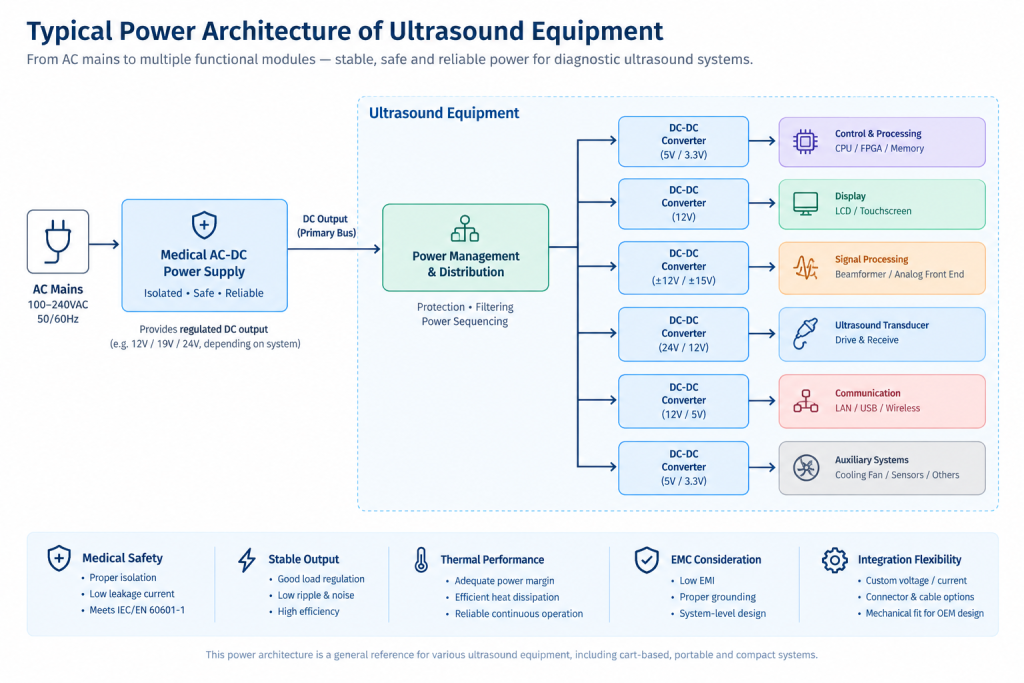
Typical Power Architecture

Customer Challenge

1. Finding a Power Supply Suitable for the Complete System

The customer’s ultrasound system consisted of several interconnected electronic modules rather than a single low-power load.

The power supply needed to provide sufficient capacity for the main system while maintaining stable output under different operating conditions.

The customer also wanted to avoid selecting a consumer-grade adapter simply based on its nominal wattage, as the power supply would become part of a professional medical device.

2. Medical Safety Requirements

The equipment was intended for professional diagnostic use, so the power supply needed to be considered as part of the medical electrical system.

The customer needed a solution compatible with the applicable medical safety architecture, including appropriate insulation, isolation, leakage current, and protection requirements.

This made the selection of a standard commercial AC-DC adapter unsuitable for the project.

3. Stable Power for Sensitive Electronics

The ultrasound system included imaging and signal-processing electronics that could be sensitive to power quality and electrical interference.

The customer therefore required a power supply with stable DC output and appropriate ripple and noise performance.

Power supply selection also needed to consider how the adapter would interact with the equipment’s internal DC-DC converters and other electronic modules.

4. Continuous Operating Requirements

The equipment was expected to support repeated and extended diagnostic operation in professional environments.

The power supply therefore needed to operate reliably under sustained load without excessive thermal stress.

The customer wanted a solution that provided sufficient operating margin rather than continuously operating close to the adapter’s maximum rated capacity.

5. Mechanical and Connection Compatibility

The customer’s enclosure and internal power architecture had already been defined, which placed additional requirements on the external power supply.

The DC connector, cable length, cable routing, and overall connection configuration needed to match the equipment design.

A standard off-the-shelf adapter would therefore require additional modifications to fit the final system.

XJK Engineering Solution

Power Architecture Evaluation

The customer’s system used an external AC-DC power supply as the primary power source, followed by internal DC-DC conversion and power distribution.

This architecture allowed the external adapter to provide a stable main DC input while the equipment’s internal power circuits generated the different voltage rails required by individual functional modules.

XJK POWER evaluated the external power supply together with this architecture to ensure that the selected power platform was appropriate for the system’s overall load requirements.

Medical Power Supply Selection

Instead of using a standard consumer power adapter, XJK POWER selected a medical-grade AC-DC power platform designed for integration into medical electrical equipment.

The selection process considered the applicable medical safety requirements, isolation architecture, operating conditions, output characteristics, and expected system load.

The final configuration was selected according to the customer’s equipment requirements rather than using a generic fixed configuration.

Output Configuration

The output voltage and current capacity were configured according to the customer’s system specification.

The engineering team also considered the equipment’s normal operating load and expected peak conditions to provide an appropriate power margin.

This helped prevent the power supply from being continuously operated at its maximum rated capacity.

Connector and Cable Customization

Because the customer’s equipment had a defined mechanical interface, XJK POWER customized the DC output configuration to match the equipment.

The project included consideration of:

  • DC connector type
  • Connector polarity
  • Cable length
  • Cable specification
  • Strain relief
  • Cable routing
  • Product labeling

This reduced the amount of additional modification required during equipment assembly.

System-Level EMC Consideration

Electrical noise and EMC were considered during power supply selection and integration.

XJK POWER evaluated the power supply’s electrical characteristics together with the customer’s system requirements, while recognizing that final EMC performance depends on the complete equipment design.

Internal PCB layout, grounding, shielding, cable routing, DC-DC conversion, and connected peripherals were therefore also considered during the engineering discussion.

Thermal and Reliability Consideration

The power rating was selected with appropriate operating margin based on the customer’s expected load profile.

The engineering team considered continuous operation, ambient conditions, power conversion efficiency, and thermal stress when evaluating the power solution.

This approach helped provide a more reliable power platform for the customer’s intended operating conditions.

How We Develop a Custom Power Supply

Our engineering process helps  device manufacturers move efficiently from requirement definition to production-ready power solutions.

Step1
Requirement
Review

Review voltage, current, connector, plug type, installation environment, and medical device requirements.

Step2
Engineering
Evaluation

Electrical feasibility assessment, connector matching, and product configuration planning.

Step3
Prototype
Development

Prototype recommendation or customized sample preparation based on project requirements.

Step4
Compliance &
Validation

Review safety expectations, EMC considerations, and application-specific requirements.

Step5
Sample
Approval

Functional verification and customer-side evaluation before production.

Step6
Production &
Delivery

OEM production support for customized healthcare power solutions.

Technical Design Considerations

Output Power and Load Margin

The power supply rating was evaluated against the ultrasound system’s actual load profile rather than relying solely on the nominal system power consumption.

Normal operating load, peak demand, connected modules, and future configuration changes were considered when determining the required power capacity.

An appropriate operating margin helps reduce thermal stress and provides greater stability during extended operation.

Output Voltage Stability

Stable DC output was an important consideration because the external power supply served as the primary input to the equipment’s internal power architecture.

The selected solution needed to maintain suitable output regulation under changing load conditions and work effectively with the equipment’s downstream DC-DC converters.

Ripple and Noise

Ultrasound systems combine sensitive electronic circuits with high-speed digital processing.

The power supply’s ripple and noise characteristics were therefore considered during the selection process.

However, power quality cannot be evaluated independently from the complete system. PCB design, grounding, filtering, shielding, and cable routing can all influence the final electrical performance.

Medical Isolation and Protection

The power supply needed to be compatible with the medical equipment’s safety architecture.

Depending on the equipment classification and system design, requirements may include appropriate means of protection, insulation, isolation, leakage current limits, and MOPP/MOOP considerations.

The applicable requirements were therefore evaluated based on the customer’s intended equipment architecture.

Thermal Management

Continuous operation places greater demands on the thermal design of the power supply.

The selected power platform was evaluated with consideration for operating load, ambient temperature, ventilation conditions, and available power margin.

Adequate thermal margin helps reduce component stress and supports long-term reliability.

Mechanical Integration

The physical connection between the power supply and the ultrasound system was also considered.

Connector dimensions, cable length, polarity, strain relief, and mechanical clearance were reviewed to ensure that the customized configuration could be integrated into the customer’s equipment without unnecessary redesign.

System-Level Compliance

The power supply was treated as one component of the complete medical electrical system.

Although the power adapter can be designed and evaluated against applicable medical standards, final compliance of the ultrasound equipment depends on the complete system, including the power supply, internal electronics, enclosure, cables, accessories, and other connected components.

Project Result

After evaluating the customer’s electrical and mechanical requirements, XJK POWER provided a customized medical AC-DC power configuration for integration into the specialized diagnostic ultrasound system.

The selected solution provided the required DC power interface for the main equipment while addressing the customer’s requirements for medical safety, stable output, continuous operation, and mechanical compatibility.

The customized connector and cable configuration also allowed the customer to integrate the external power supply directly into the equipment’s existing design.

The project delivered several key benefits:

Stable Power for the Ultrasound System
The medical AC-DC power supply provided a regulated DC input for the equipment’s main power architecture.

Improved Integration Efficiency
Customized output and connection configurations reduced the need for additional cable or connector modifications during equipment integration.

Medical Safety-Oriented Design
The power solution was selected with consideration for the applicable medical electrical safety requirements of the customer’s equipment.

Suitable for Continuous Operation
The power capacity and operating margin were evaluated according to the expected load profile and intended use of the equipment.

OEM-Ready Configuration
The solution could be customized to match the customer’s electrical, mechanical, and production requirements.

The project gave the customer a practical medical power platform that could be integrated into its specialized ultrasound equipment while maintaining flexibility for future product configurations.

Recommended Products

60W Medical Power Adapter

A compact option for lower-power diagnostic ultrasound systems and specialized medical equipment with moderate power requirements. Typical configurations can be customized according to the equipment's required voltage, current, connector, and cable specification.

90W Medical Power Adapter

A suitable power platform for specialized ultrasound systems requiring additional capacity for imaging electronics, processing circuits, display systems, and control modules.

FAQ

Why does diagnostic ultrasound equipment need a specialized power supply?

Diagnostic ultrasound equipment contains imaging, signal-processing, display, and control electronics that operate together as an integrated medical system.

The power supply therefore needs to provide stable power while also being compatible with the equipment’s medical safety architecture, operating conditions, and EMC requirements.

A standard consumer-grade adapter may not provide the appropriate electrical safety characteristics or integration flexibility required for professional medical equipment.

What voltage and power rating are suitable for ultrasound equipment?

There is no single power rating suitable for all ultrasound systems.

The required voltage and power depend on the equipment architecture, internal DC-DC conversion, display, imaging electronics, peripherals, and expected operating load.

Common DC input platforms may include 19V or 24V, while power requirements can vary from compact lower-power systems to higher-power professional platforms.

The correct configuration should be determined from the equipment’s actual electrical specifications.

Can XJK POWER customize the power supply for a specific ultrasound system?

Yes.

XJK POWER can customize the power configuration according to the customer’s equipment requirements.

Customization may include output voltage, current and power rating, DC connector, cable length, cable specification, labeling, and other OEM requirements.

For a new project, customers can provide their electrical specifications and mechanical interface requirements for engineering evaluation.

Does the power supply itself guarantee IEC 60601-1 compliance for the ultrasound equipment?

No.

A medical power supply can be designed and evaluated according to applicable IEC/EN 60601-1 requirements, but compliance of the complete ultrasound equipment must be assessed at the system level.

The final result can also depend on the equipment’s internal circuitry, grounding, insulation, enclosure, cables, accessories, and other connected components.
XJK POWER can support the power supply side of the design while the medical equipment manufacturer remains responsible for complete system compliance.

Developing a Diagnostic Ultrasound System?

Choosing the right power supply early in the equipment development process can simplify system integration and help avoid redesign caused by unsuitable voltage, connectors, thermal performance, or medical safety requirements.

XJK POWER provides customized medical AC-DC power solutions for diagnostic ultrasound equipment and other medical electronic systems.

Share your required output voltage, current, power rating, connector specification, and medical safety requirements with our engineering team.

Related Resources

Request a Quote

Leave your requirements and we’ll get back to you within 24 hours.