| Standard | Application | Main Focus |
|---|---|---|
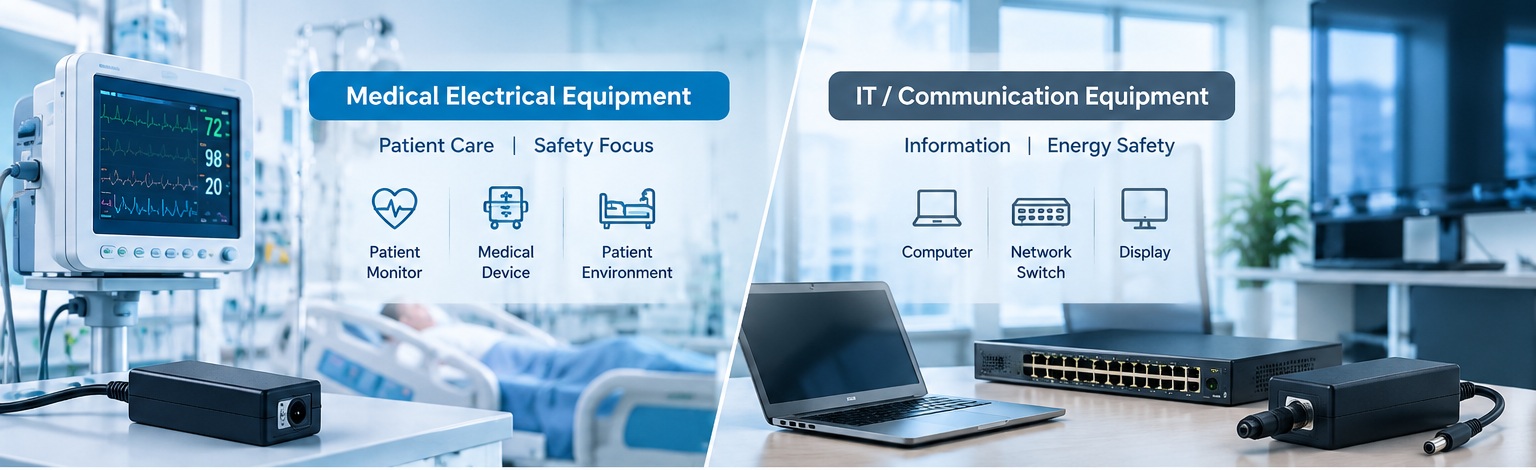
| IEC 62368-1 | Industrial, ICT equipment | Product safety |
| IEC 60601-1 | Medical equipment | Patient protection |
| UL 62368-1 | North America | Safety |
| EN 62368-1 | Europe | Safety compliance |
Introduction
When developing electronic products for global markets, selecting the right power adapter is not only an electrical design decision but also a compliance decision.
A power adapter that meets the required voltage and current specifications may still fail during product certification if it does not comply with the correct safety standards.
Different applications require different compliance requirements. For example:
- Medical equipment requires enhanced protection against electric shock and patient risk.
- Industrial equipment requires reliable operation and safety compliance under demanding environments.
- Commercial electronics require compliance with regional regulations such as CE or UL.
Understanding power adapter certifications early in the product development process helps OEM companies reduce certification risks, avoid redesign costs, and accelerate time to market.
This guide explains the major AC/DC power adapter safety standards, certification requirements, and key considerations when selecting a reliable power supply supplier.
Why Power Adapter Certification Matters for OEM Projects
For OEM customers, certification is not simply a document requirement. It directly affects product safety, market access, and long-term reliability.
1. Ensure Product Safety
Power adapters convert high-voltage AC input into low-voltage DC output.
Poorly designed power supplies may create risks including:
- Electric shock
- Overheating
- Insulation failure
- Fire hazards
- Equipment damage
Safety standards define requirements for:
- Insulation systems
- Leakage current
- Dielectric strength
- Protection mechanisms
- Component selection
2. Support Global Market Access
Different regions have different regulatory requirements.
Common examples include:
| Region | Common Requirements |
|---|---|
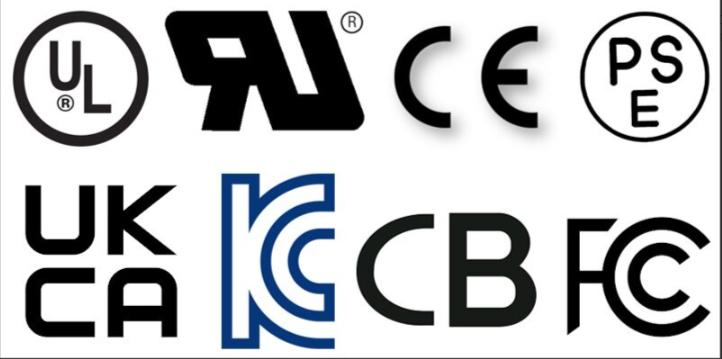
| European Union | CE, RoHS, IEC/EN standards |
| United States | UL standards, FCC EMC requirements |
| Canada | CSA requirements |
| Japan | PSE certification |
| Australia/New Zealand | RCM requirements |
Choosing a power adapter supplier with international certification experience helps simplify global product launches.
3. Reduce Product Development Risks
Certification problems discovered at the final testing stage can cause:
- Product redesign
- Additional testing costs
- Project delays
- Production interruptions
Selecting a compliant power solution during the early design stage helps avoid these risks.
Common Safety Standards for AC/DC Power Adapters
Different applications require different safety standards.
The most common standards for AC/DC power adapters include:
| Standard | Main Application | Purpose |
|---|---|---|
| IEC 62368-1 | Industrial, IT, networking equipment | Product safety |
| IEC 60601-1 | Medical electrical equipment | Patient and operator protection |
| UL 62368-1 | North American markets | Safety compliance |
| EN 62368-1 | European markets | Safety compliance |
IEC 62368-1 Power Adapter Safety Standard
What is IEC 62368-1?
IEC 62368-1 is one of the most widely used safety standards for information technology equipment, communication equipment, and many industrial electronic products.
Unlike older standards that classified products by category, IEC 62368-1 uses a hazard-based safety engineering approach.
It evaluates:
- Energy sources
- Potential hazards
- Protection methods
Applications Using IEC 62368-1 Power Supplies
Typical applications include:
- Networking equipment
- Industrial computers
- Embedded systems
- Communication devices
- Control equipment
Key Safety Considerations
Power adapters designed according to IEC 62368-1 must consider:
Electrical insulation
Prevent dangerous voltage transfer between circuits.
Energy limitation
Control potentially hazardous energy levels.
Temperature control
Prevent excessive heating during operation.
Component safety
Ensure critical components meet reliability requirements.
IEC 60601-1 Medical Power Supply Standard
What is IEC 60601-1?
IEC 60601-1 is the primary international safety standard for medical electrical equipment.
Medical power supplies have stricter requirements than standard commercial adapters because failures may directly affect patient safety.
Key Requirements for Medical Power Supplies
Medical power supplies must consider:
Means of Protection (MOP)
Protection against electric shock is categorized into:
- MOOP (Means of Operator Protection)
- MOPP (Means of Patient Protection)
Leakage Current
Medical applications require strict limits on leakage current to reduce electrical shock risks.
Insulation Requirements
Medical power supplies may require:
- Basic insulation
- Reinforced insulation
- Multiple protection levels
Reliability Requirements
Medical equipment often requires:
- Long operating life
- Stable output performance
- High reliability
MOPP vs MOOP: Understanding Medical Protection Levels
One of the most important concepts in medical power supply design is the difference between MOPP and MOOP.
MOOP
Means of Operator Protection
MOOP protects users who operate medical equipment but are not directly connected to the patient.
Examples:
- Laboratory equipment
- Medical monitors
- Diagnostic systems
MOPP
Means of Patient Protection
MOPP provides a higher level of protection because patients may be physically connected to medical equipment.
Applications may include:
- Patient monitoring equipment
- Medical imaging systems
- Patient-connected devices
Why MOPP Requirements Matter
A higher protection level usually requires:
- Increased insulation distance
- Higher dielectric strength
- Better isolation design
For medical OEM projects, selecting the correct MOPP/MOOP level at the beginning of development is critical.
CE Certification for Power Adapters
What Does CE Mean?
CE marking indicates that a product complies with applicable European Union safety, health, and environmental requirements.
For AC/DC power adapters, CE compliance commonly involves:
- Electrical safety
- EMC performance
- Environmental requirements
Common CE-Related Requirements
Depending on the product application, evaluation may include:
Low Voltage Directive (LVD)
Ensures electrical safety.
EMC Requirements
Ensures the product does not create unacceptable electromagnetic interference.
RoHS Compliance
Restricts hazardous substances in electronic products.
Important Note for OEM Buyers
CE marking alone does not represent a single certification test.
A complete compliance evaluation depends on:
- Product category
- Applicable standards
- Intended market
- Technical documentation
UL Certification for Power Adapters
What is UL Certification?
UL is one of the most recognized safety organizations in North America.
For power adapters entering the US market, UL-related compliance is often an important customer requirement.
UL Listed vs UL Recognized
UL Listed
Applies to complete products that have been evaluated for safety.
UL Recognized
Applies mainly to components used inside larger systems.
OEM customers should confirm whether they require:
- A fully certified adapter
- Certified internal components
Common Mistakes When Selecting a Certified Power Adapter
Mistake 1: Assuming CE Means Global Certification
CE certification only applies to specific European requirements.
It does not automatically replace:
- UL requirements
- Medical standards
- Other regional certifications
Mistake 2: Ignoring Application Requirements
A standard industrial adapter may not be suitable for medical applications.
Different industries require different standards.
For example:
Medical equipment:
- IEC 60601-1
Industrial equipment:
- IEC 62368-1
Mistake 3: Selecting a Certified Product Without Checking Scope
Certification applies to a specific product design.
Changes to:
- Components
- PCB design
- Transformer
- Enclosure
- Output cable
may affect certification validity.
Mistake 4: Considering Certification Too Late
Certification requirements should be considered during:
- Product design
- Component selection
- Prototype development
not after mass production preparation.
How OEM Buyers Should Evaluate a Power Adapter Supplier
When selecting a power supply manufacturer, OEM companies should consider:
Certification Experience
Does the supplier understand:
- IEC standards?
- Regional requirements?
- Industry-specific compliance?
Engineering Support
Can the supplier help with:
- Safety design
- Specification review
- Certification preparation?
Production Consistency
Can the supplier maintain:
- Stable quality
- Same certified design
- Long-term supply?
Documentation Support
A professional supplier should provide:
- Test reports
- Certification documents
- Technical specifications
XJK Power Certification & Compliance Support
XJK Power provides customized AC/DC power adapter solutions for medical, industrial, and commercial applications.
Our engineering team supports customers with:
Safety Requirement Evaluation
We help analyze:
- Application requirements
- Applicable standards
- Certification targets
Customized Power Supply Development
Support includes:
- Electrical design
- Mechanical customization
- Connector selection
- Reliability optimization
Certification Support
Depending on application requirements, XJK Power supports products designed for:
- IEC 60601-1 medical power supplies
- IEC 62368-1 industrial power adapters
- CE compliance
- CB certification
From prototype development to mass production, we help OEM customers develop reliable and compliant power solutions.
Conclusion
Choosing the right power adapter requires more than matching voltage and power ratings.
Understanding safety standards, certification requirements, and application-specific compliance helps OEM companies develop safer products, reduce certification risks, and accelerate market launch.
With experience in medical and industrial power applications, XJK Power supports customers with customized AC/DC power solutions from design evaluation to mass production.