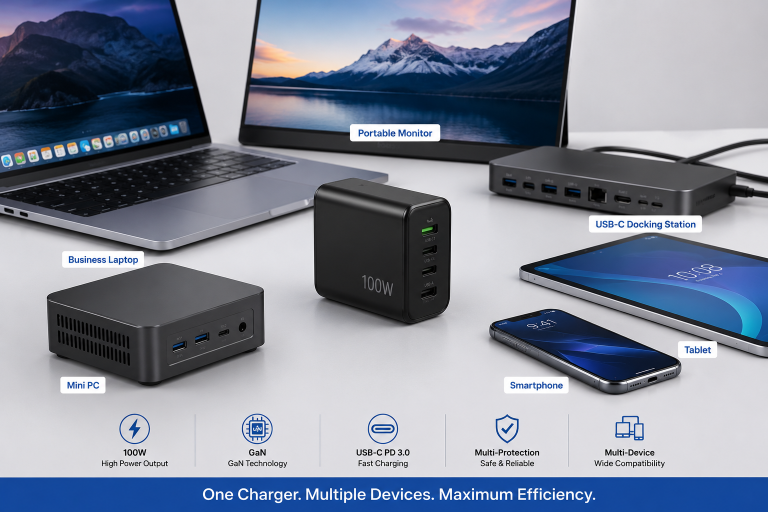
As USB-C Power Delivery (PD) becomes the universal charging standard, 100W GaN chargers are rapidly expanding beyond consumer electronics. Today, they are widely used to power business laptops, portable monitors, docking stations, mini PCs, commercial terminals, and many other professional devices.
Compared with conventional silicon-based chargers, GaN (Gallium Nitride) technology enables higher power density, improved energy efficiency, and a much smaller form factor without sacrificing performance. These advantages make 100W GaN chargers an excellent choice for professionals who need reliable, high-power charging in a compact package.
For OEM manufacturers, adopting a 100W USB-C GaN charger can also simplify product design by standardizing USB-C PD charging across multiple product lines while reducing shipping costs and improving user experience.
In this article, we’ll explore ten real-world applications where 100W GaN chargers deliver practical value and explain why 100W has become one of the most popular power levels for today’s commercial and portable devices.
Related Reading: If you’re comparing different models or selecting a charger for your next project, don’t miss our guide: How to Choose a 100W GaN Charger: Key Specs, Safety & Compatibility Guide.
Why 100W Has Become the Most Popular GaN Charger Power Level
While GaN chargers are available in power ratings ranging from 30W to over 200W, the 100W class has become one of the most versatile options on the market.
For many professionals, 100W provides the ideal balance between power, portability, and compatibility. It delivers enough output for power-hungry laptops and commercial equipment while remaining compact enough for everyday travel.
Several factors have contributed to the popularity of 100W GaN chargers:
- USB-C Power Delivery supports multiple voltage profiles up to 100W.
- Modern business laptops increasingly support USB-C charging.
- Professionals often carry multiple USB-C devices that can share one charger.
- Compact GaN technology reduces both size and weight compared with traditional chargers.
- A single 100W charger can replace several lower-power adapters.
For manufacturers, offering products compatible with 100W USB-C PD charging also improves flexibility and aligns with the industry’s ongoing transition toward standardized USB-C power solutions.
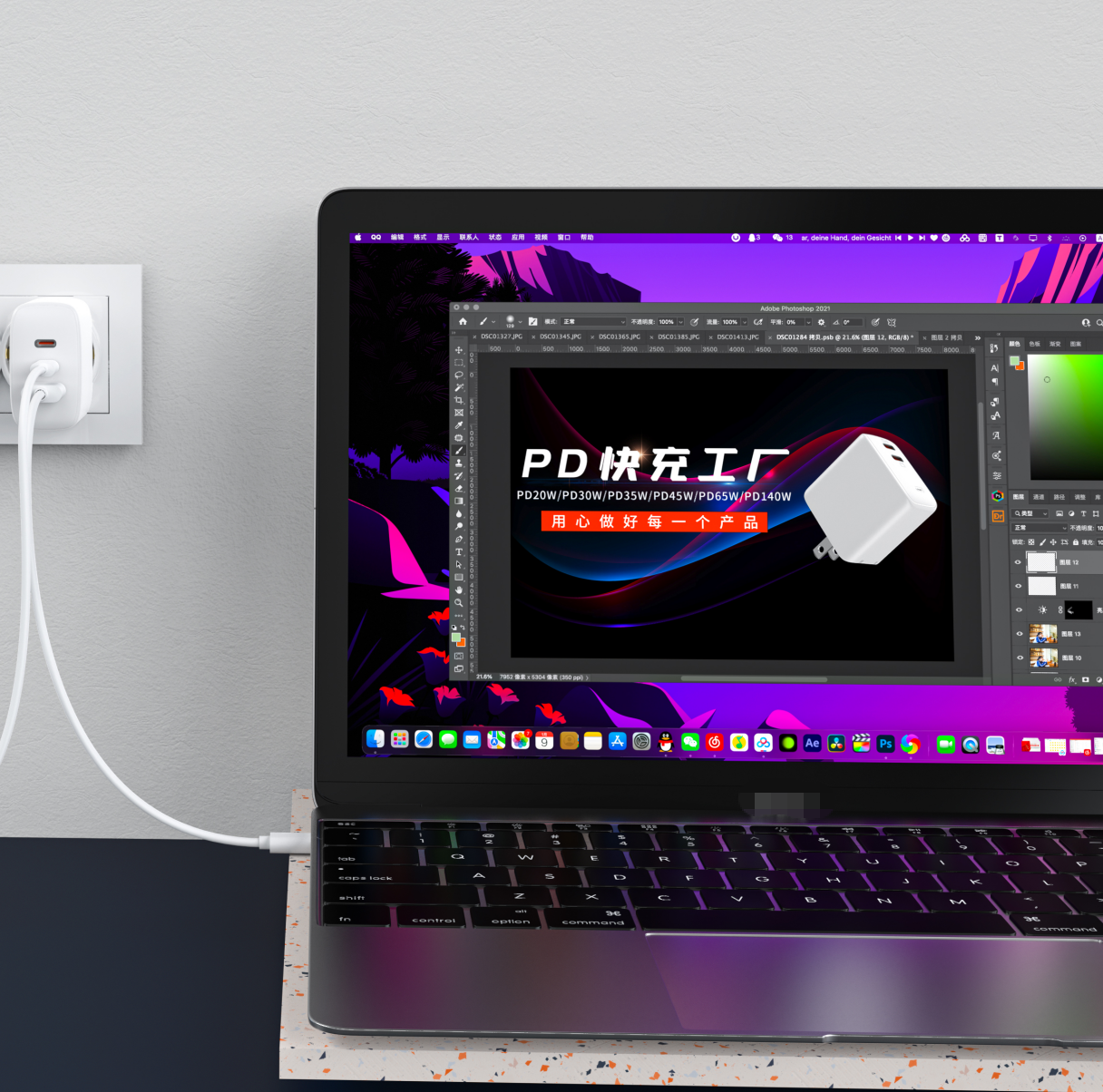
1. Business Laptops (65–100W)
Business laptops remain the primary and most stable application for 100W GaN chargers.
Typical devices include:
- MacBook Air / MacBook Pro 13–14”
- Dell XPS series
- Lenovo ThinkPad X / T series
- HP EliteBook series
Why it fits 100W GaN chargers
Modern ultrabooks increasingly rely on USB-C PD input within the 65W–100W range. A 100W GaN charger ensures:
- Full-speed charging under workload
- Compatibility with performance peaks (CPU/GPU bursts)
- One charger replacement for OEM + travel use cases
Commercial value
This category drives the highest adoption rate, especially in:
- Enterprise mobility
- Remote work setups
- IT standardization programs
2. USB-C Docking Stations (45–90W) — Office Ecosystem Power Hub
USB-C docking stations are one of the most important “hidden” use cases for 100W GaN chargers.
Typical docking functions:
- Multi-display output (HDMI/DP)
- Ethernet connectivity
- USB expansion hubs
- Laptop charging pass-through
Why 100W GaN is suitable
Most PD docking stations require:
- 65W (standard docks)
- 90W (multi-display docks)
A 100W GaN charger provides:
- Stable upstream power input
- Reduced dock power bottleneck
- Simplified desk setup (single compact PSU)
Typical deployment
- Corporate office desks
- Co-working environments
- Hot-desking systems
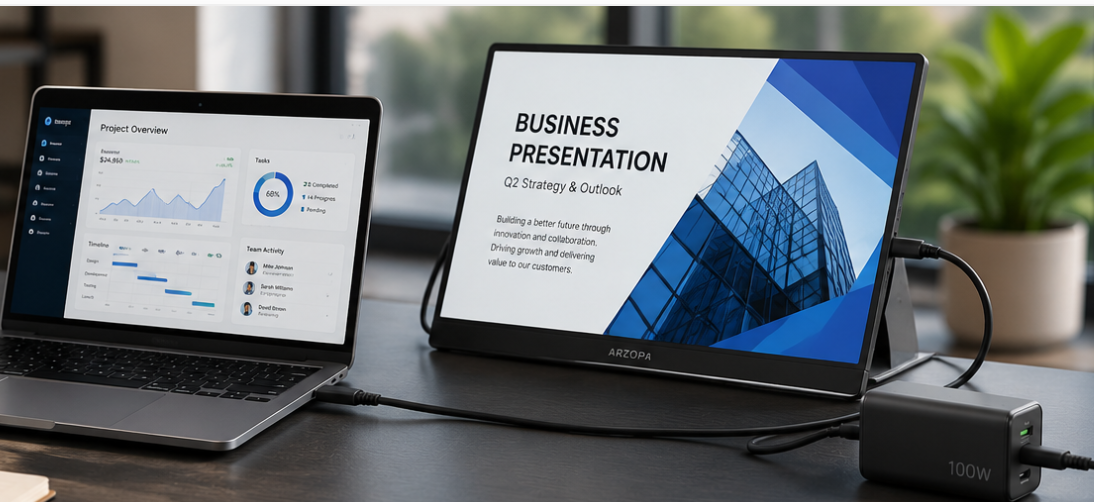
3. Portable Monitors (15–60W) — Mobile Productivity Displays
Portable monitors (typically 13–17 inches) are widely used in mobile work environments.
They often operate via:
- USB-C single-cable video + power
- Low-to-mid power consumption design
Power characteristics
- Basic models: 7.5W–15W
- Touch or high-brightness models: up to 30–60W
Why 100W GaN is used
Although not required at full capacity, 100W chargers provide:
- Shared power source for laptop + monitor
- Stable multi-device setup
- Travel-friendly consolidation
Key scenario
- Mobile workstation setups
- Field engineering laptops
- Business travel dual-screen environments
4. Smartphones & Tablets (10–45W) — Multi-Device Charging Ecosystem
Modern smartphones and tablets increasingly support USB-C PD fast charging.
Typical ranges:
- Smartphones: 20W–45W
- Tablets: 20W–30W (some up to 45W)
Examples:
- iPhone (20–30W PD)
- Samsung Galaxy (25–45W Super Fast Charging)
- iPad / Android tablets
Why include them in 100W GaN use cases
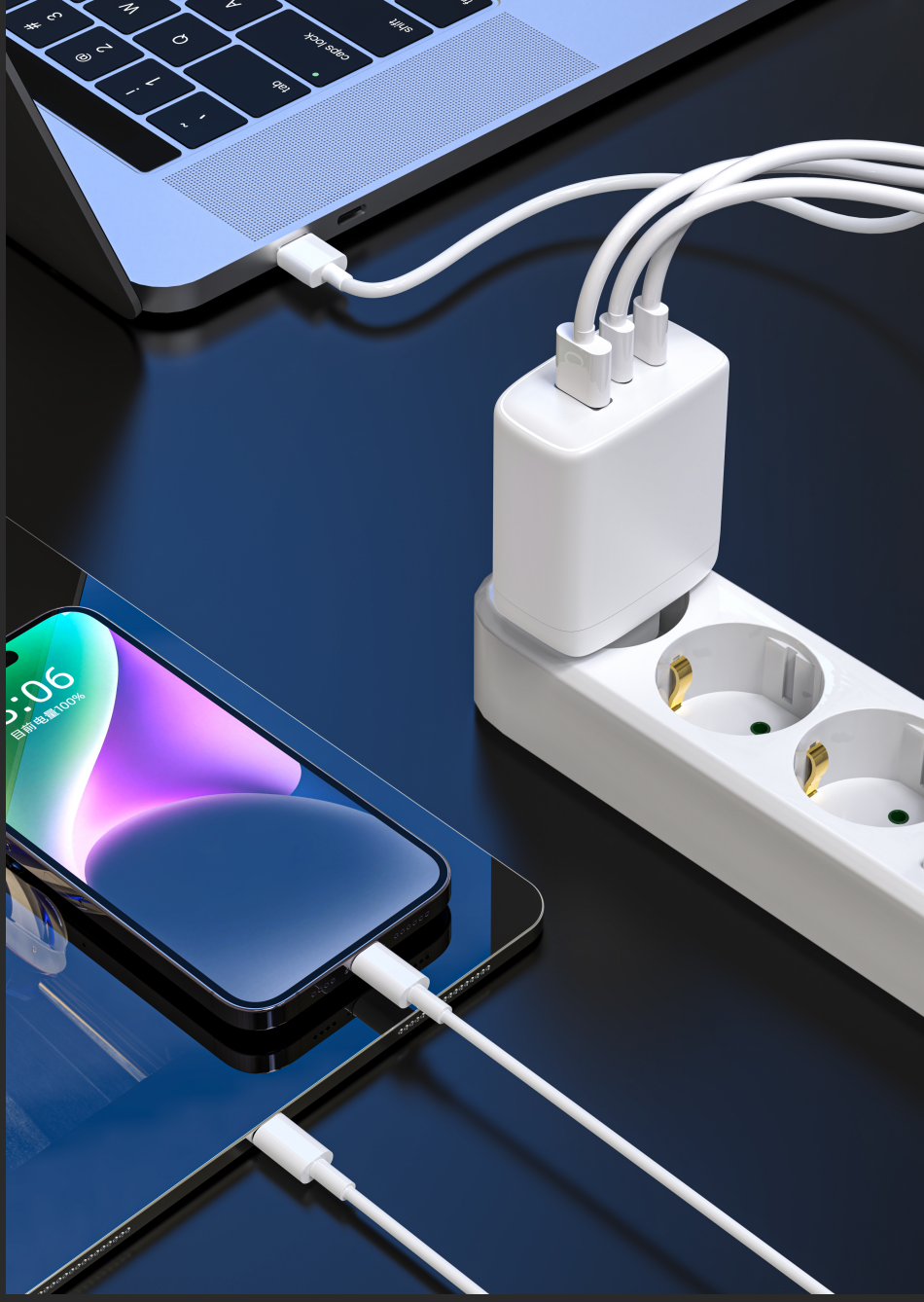
The value is not power requirement, but consolidation:
- One charger replaces laptop + phone + tablet adapters
- Reduces travel load
- Standardizes charging infrastructure
5. Travel & Mobile Workstation Charging
This is the most commercially important application of 100W GaN chargers.
Typical device combination
- Laptop (65–100W)
- Smartphone (20–45W)
- Portable monitor (15–60W)
- Earbuds / accessories (5–15W)
Core value proposition
Instead of carrying multiple chargers, users rely on:
One 100W GaN charger to power an entire mobile office setup.
Why GaN enables this scenario
- High efficiency reduces heat during multi-device charging
- Compact size improves portability
- Smart power distribution via PD protocol
Commercial applications
- Business travel kits
- Airline / hotel charging setups
- Remote work “mobile office” packages
Conclusion
The real-world value of a 100W GaN charger is not maximum output power, but:
A unified USB-C PD power platform for laptops and mobile productivity devices.
When properly positioned, its strongest applications are:
- Business laptops (core load)
- USB-C docking stations (office infrastructure)
- Portable monitors (mobile productivity)
- Smartphones & tablets (ecosystem consolidation)
- Travel multi-device charging (highest commercial value scenario)
By focusing on these five validated categories, manufacturers and OEM suppliers can avoid overgeneralization and build credible, engineering-aligned marketing content that matches actual deployment behavior.
How to Choose the Right 100W GaN Charger
Not all 100W GaN chargers deliver the same performance. When selecting a charger for commercial use or OEM integration, consider the following factors:
- USB-C PD protocol compatibility
- Single-port or multi-port output
- Continuous power output capability
- Energy efficiency
- Thermal management
- Global safety certifications
- Regional AC plug options
- OEM and ODM customization services
If you’re evaluating suppliers or comparing technical specifications, we recommend reading our detailed guide:
→ How to Choose a 100W GaN Charger: Key Specs, Safety & Compatibility Guide
That article explains USB-C PD profiles, safety standards, connector options, and key engineering considerations in greater detail, helping you select the right charger for your application.
Recommended XJK Solutions
① Single-Port 100W GaN Charger
Best For
- Business laptops
- Mini PCs
- Portable monitors
- Developer kits
② Dual-Port 100W GaN Charger
Best For
- Mobile office
- POS
- Tablets
- Smartphones
③ Custom OEM GaN Charger
Best For
- Equipment manufacturers
- Brand owners
- Industrial OEM
- Commercial OEM