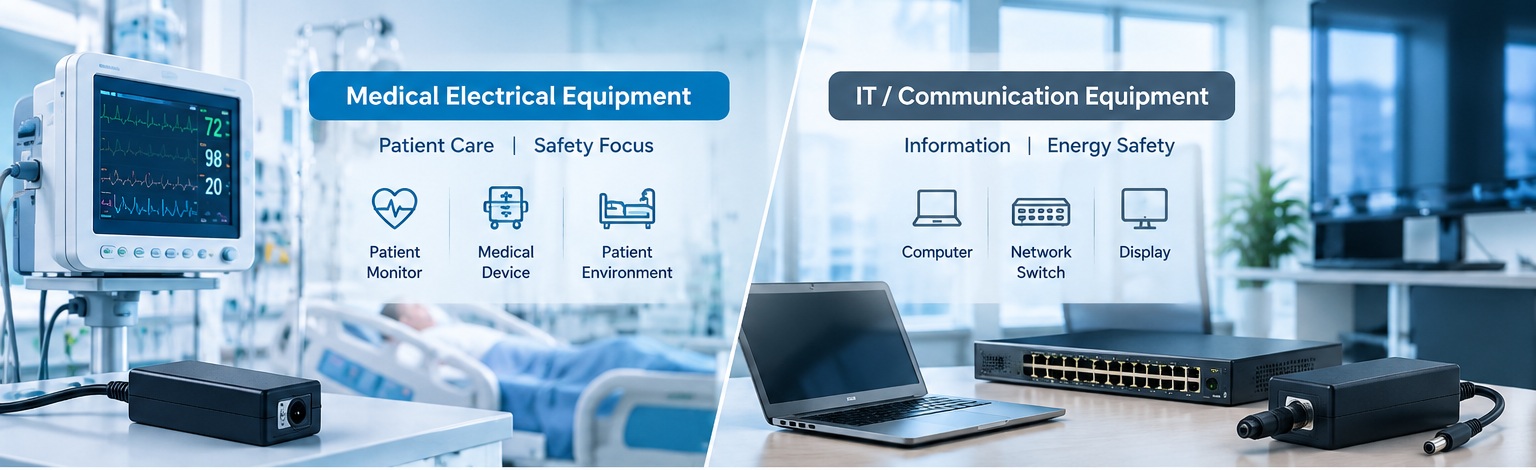
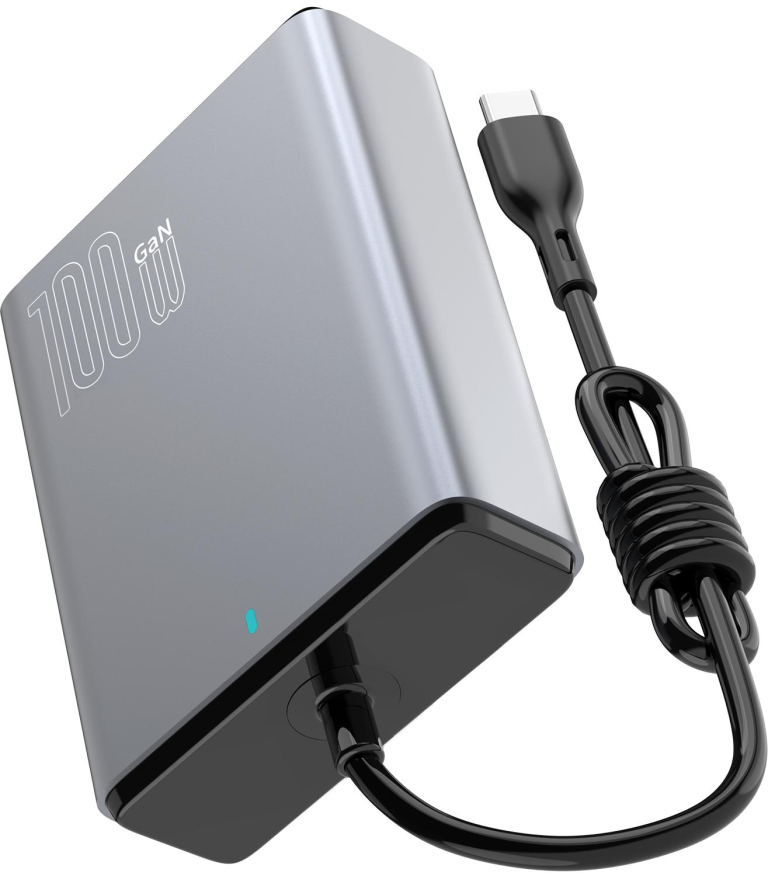
Modern electronic devices require more power than ever before. From laptops and industrial tablets to portable medical equipment and commercial terminals, reliable high-power charging has become a critical requirement. As USB-C Power Delivery (PD) technology continues to evolve, 100W GaN PD chargers have emerged as a compact, efficient, and versatile power solution for a wide range of applications.
However, not all 100W chargers are created equal. Selecting the right charger involves more than simply checking the wattage rating. Factors such as USB-C PD compatibility, safety certifications, efficiency, thermal performance, and long-term reliability all play an important role in ensuring stable operation.
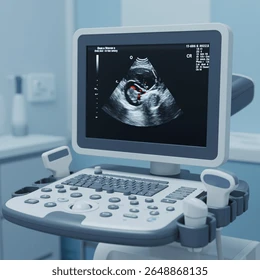
Many portable medical devices and healthcare terminals now rely on compact USB-C PD power solutions, especially in applications that require reliable medical-grade power delivery.
This guide explains the key specifications, safety requirements, and compatibility considerations that engineers, OEM manufacturers, and equipment designers should evaluate when choosing a 100W GaN PD charger.
What Is a 100W GaN PD Charger?
A 100W GaN PD charger is a power adapter that combines Gallium Nitride (GaN) semiconductor technology with USB-C Power Delivery (PD) fast-charging protocols.
Compared with traditional silicon-based chargers, GaN chargers offer:
- Higher power density
- Smaller size and lighter weight
- Improved conversion efficiency
- Lower heat generation
- Better thermal management
Meanwhile, USB-C Power Delivery allows intelligent negotiation between the charger and connected devices, automatically delivering the required voltage and current.
What Is GaN Technology?
Gallium Nitride is a next-generation semiconductor material that switches electrical current more efficiently than conventional silicon components.
Because GaN transistors can operate at higher frequencies with lower energy loss, manufacturers can reduce transformer size and improve overall efficiency without sacrificing output power.
As a result, a modern 100W GaN charger can be significantly smaller than a traditional 100W power adapter while maintaining excellent performance.
What Is USB-C Power Delivery?
USB-C Power Delivery (PD) is a fast-charging standard that enables devices and chargers to communicate and negotiate power requirements dynamically.
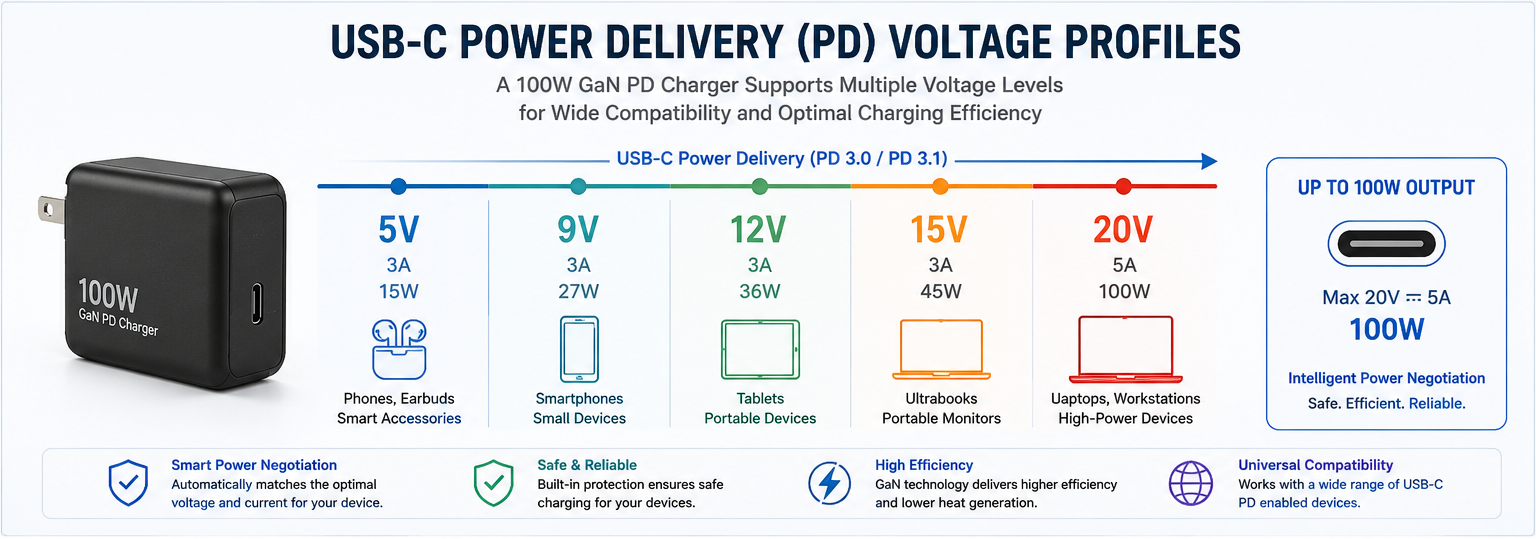
Common PD voltage profiles include:
- 5V
- 9V
- 12V
- 15V
- 20V
A typical 100W PD charger can provide up to:
- 20V / 5A
- Total Output: 100W
This makes it suitable for powering laptops, docking stations, industrial tablets, portable medical devices, and other high-power equipment.
How GaN and PD Work Together
GaN technology improves power conversion efficiency, while USB-C PD ensures intelligent power delivery. Together they create a charger that is compact, energy-efficient, and compatible with a wide range of devices.
Key Specifications to Evaluate
When selecting a 100W GaN PD charger, several technical specifications should be carefully reviewed.
Output Power and Voltage Profiles
The first factor is supported output profiles.
Most professional-grade 100W chargers should support:
| Voltage | Current | Power |
|---|---|---|
| 5V | 3A | 15W |
| 9V | 3A | 27W |
| 12V | 3A | 36W |
| 15V | 3A | 45W |
| 20V | 5A | 100W |
Supporting multiple voltage levels allows a single charger to power different devices safely and efficiently.
For industrial and commercial applications, PD 3.0 or PD 3.1 compatibility is highly recommended.
Single-Port vs Multi-Port Design
The intended application should determine whether a single-port or multi-port charger is more suitable.
Single-Port Chargers
Advantages:
- Maximum power available on one port
- Simpler thermal design
- Higher reliability for dedicated equipment
Common applications:
- Industrial tablets
- Medical workstations
- Embedded systems
- Rugged computers
Multi-Port Chargers
Advantages:
- Simultaneous charging of multiple devices
- Improved convenience
- Reduced cable clutter
Common applications:
- Office workstations
- Retail environments
- Conference systems
Efficiency and Thermal Performance
Power conversion efficiency directly impacts reliability.
Higher efficiency means:
- Lower operating temperature
- Reduced energy waste
- Longer component lifespan
- Improved system stability
A high-quality GaN charger typically achieves significantly better efficiency than conventional silicon-based chargers.
For industrial and medical environments where equipment may operate continuously, thermal performance should be considered a critical design factor.
Input Voltage Range
Global OEM products typically require universal input support.
Recommended specification:
- Input: 100–240VAC
- Frequency: 50/60Hz
This allows the same charger platform to be deployed worldwide with minimal modification.
Safety and Certification Requirements
Safety is often more important than charging speed.
For commercial, industrial, and medical applications, certified power solutions reduce compliance risks and improve end-product reliability.
For industrial tablets, rugged computers, and embedded systems, engineers often evaluate the charger as part of a broader industrial power supply strategy.
UL, CE, FCC, and CB Certifications
Depending on the target market, manufacturers should verify compliance with relevant standards.
Common certifications include:
- UL (United States)
- CE (European Union)
- FCC (Electromagnetic Compatibility)
- CB Scheme (International Certification)
Certified chargers simplify product approval processes and reduce market-entry barriers.
Over-Voltage Protection (OVP)
OVP prevents excessive voltage from reaching connected devices.
Without proper protection, sensitive electronics may suffer permanent damage during abnormal operating conditions.
Over-Current Protection (OCP)
OCP limits current when connected devices attempt to draw more power than the charger can safely provide.
This feature protects both the charger and the connected equipment.
Short-Circuit Protection (SCP)
Short-circuit protection automatically shuts down output when a fault occurs, helping prevent component failure and fire hazards.
Over-Temperature Protection (OTP)
Continuous operation at elevated temperatures can significantly reduce product lifespan.
OTP monitoring helps maintain safe operating conditions by reducing output or shutting down the charger when internal temperatures exceed safe limits.
Importance of Certified Power Solutions for OEM Products
For OEM and ODM projects, choosing certified power adapters can shorten development cycles and reduce compliance costs.
Many equipment manufacturers prefer power solutions that already meet regulatory requirements because this simplifies product integration and testing.
Compatibility Considerations
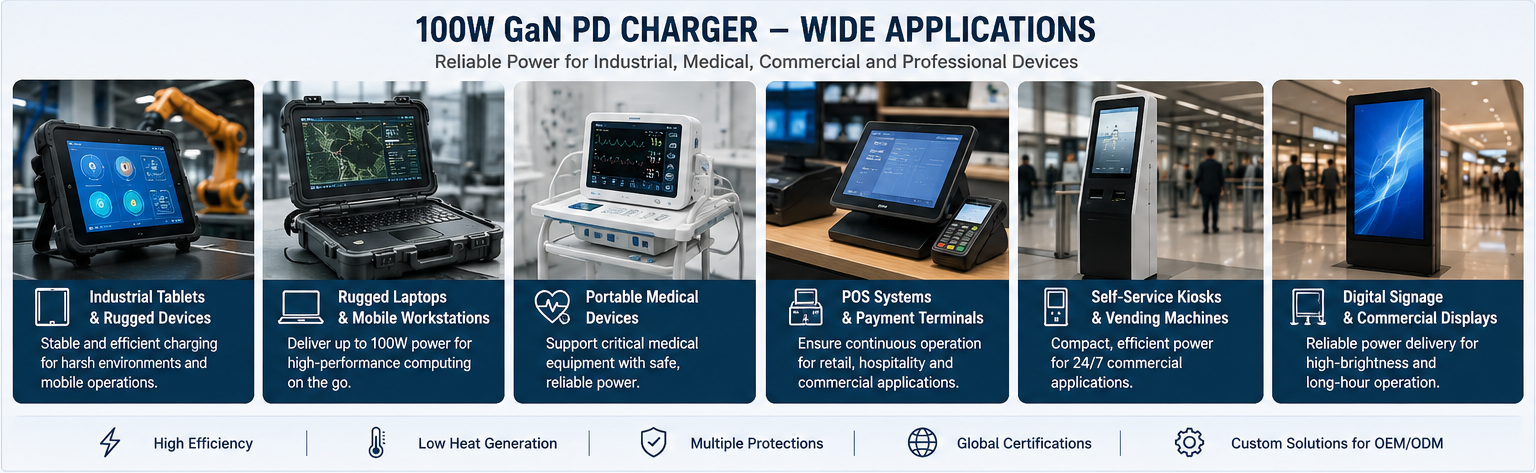
A 100W charger must not only provide sufficient power but also support the target device correctly.
Laptops and Mobile Workstations
Modern laptops increasingly rely on USB-C PD charging.
Examples include:
- Business laptops
- Mobile workstations
- Engineering notebooks
- Design workstations
Verify that the charger supports the voltage profiles required by the device manufacturer.
Industrial Tablets and Rugged Computers
Industrial equipment often operates in demanding environments.
Key considerations include:
- Continuous operation
- Temperature stability
- Shock and vibration resistance
- Long-term reliability
Industrial-grade GaN chargers can provide compact power solutions without sacrificing performance.
Portable Medical Devices
Medical equipment requires dependable power delivery and strict safety standards.
Typical applications include:
- Portable diagnostic systems
- Patient monitoring equipment
- Medical workstations
- Healthcare terminals
Manufacturers should ensure compliance with applicable medical regulations when integrating power solutions into healthcare products.
POS Systems and Self-Service Kiosks
Retail and commercial equipment increasingly utilizes USB-C power delivery due to its flexibility and universal compatibility.
Applications include:
- POS terminals
- Self-service kiosks
- Payment systems
- Information terminals
Digital Signage and Commercial Equipment
Digital signage systems often require reliable power delivery in public environments.
Compact 100W GaN chargers help reduce installation space while maintaining stable operation.
How OEMs Choose a Reliable GaN PD Charger Supplier
Selecting the right supplier is just as important as selecting the charger itself.
Many equipment manufacturers prefer suppliers that can provide custom OEM power solutions, certification support, and long-term production stability.
Custom Branding Options
OEM projects often require:
- Custom logos
- Customized packaging
- Product labeling
- Retail branding
Housing and Connector Customization
Different applications may require:
- USB-C cables
- DC connectors
- Locking connectors
- Customized enclosure designs
Regional Certification Support
An experienced supplier can assist with:
- UL certification
- CE compliance
- CB reports
- EMC testing
Long-Term Supply Stability
For industrial products with long life cycles, supply continuity is essential.
Manufacturers should evaluate:
- Production capacity
- Component sourcing strategy
- Quality management systems
- Change notification procedures
Manufacturing and Quality Control
Reliable suppliers implement strict quality controls throughout production.
Important indicators include:
- Incoming material inspection
- Functional testing
- Burn-in testing
- Final quality verification
Common Mistakes When Choosing a 100W Charger
Selecting Based Only on Wattage
Power output alone does not guarantee compatibility.
Voltage profiles, PD support, efficiency, and safety features must also be evaluated.
Ignoring PD Compatibility
A charger may provide 100W but still fail to support specific PD requirements.
Always verify supported protocols and output profiles.
Overlooking Safety Certifications
Uncertified products may create compliance issues, warranty problems, and safety risks.
Using Consumer Chargers in Industrial Equipment
Consumer products are often optimized for occasional use.
Industrial applications typically require higher reliability, longer operating life, and more rigorous testing.
Conclusion
Choosing the right 100W GaN PD charger requires evaluating more than output power alone. Engineers and purchasing teams should carefully consider USB-C PD compatibility, efficiency, safety certifications, thermal performance, and supplier capabilities before making a decision.
For industrial, commercial, and medical applications, a high-quality certified power solution can improve reliability, simplify compliance, and support long-term product success.
If you are developing a new device or seeking a custom charging solution, partnering with an experienced OEM power supply manufacturer can help ensure optimal performance and regulatory compliance.
To explore real-world deployment scenarios, see our guide on 100W GaN charger applications in industrial and commercial devices.