Introduction: Why Power Margin Matters for Power Adapters
In industrial and embedded systems, reliable power delivery is critical. Power failures rarely occur at nominal load—they usually happen during startup, load spikes, temperature extremes, or as components age.
Power margin ensures that your AC-DC or DC-DC power adapters can handle real-world operating conditions, maintaining system stability without oversizing unnecessarily. Correctly calculating margin prevents device resets, unexpected downtime, and shortens troubleshooting cycles.
Example: A 120W AC-DC adapter may deliver enough power for average operation, but without proper margin calculation, transient loads or temperature rise could still cause system failures.
1. What Is Power Margin?
Power margin is the difference between:
- The maximum available output power of your power adapter
- The peak actual power demand of the system under worst-case conditions
It is usually expressed as a percentage.
Systems with zero or insufficient margin may pass lab tests but fail in the field. Correct margin ensures that your power adapters reliably handle startup currents, peripheral activation, and load transients..
In embedded and industrial systems, power failures rarely happen at nominal load.
They occur during startup, load transients, temperature extremes, or long-term aging.
Power margin is not about oversizing the power supply—it is about ensuring stability under real operating conditions.
2. Identifying True Maximum Load
One common mistake is calculating power margin based on average power consumption. For embedded and industrial devices, engineers should consider:
- Startup current (inrush and initialization of circuits)
- Peak load spikes during processing, communication bursts, or sensor activation
- Temperature-related current increases
- Peripheral devices (relays, motors, sensors)
Datasheet “typical current” values are rarely sufficient for accurate power margin calculation.
3. Identify the True Maximum Load (Not the Typical Load)
One of the most common mistakes is calculating margin based on average consumption.
Engineers must consider:
- Startup current (inrush and initialization)
- Peak load during communication or processing bursts
- Peripheral activation (relays, motors, sensors)
- Temperature-related current increase
Datasheet “typical current” values are rarely sufficient for margin calculations.
4. Basic Power Margin Calculation (Step-by-Step)
Step 1: Calculate Maximum Load Power
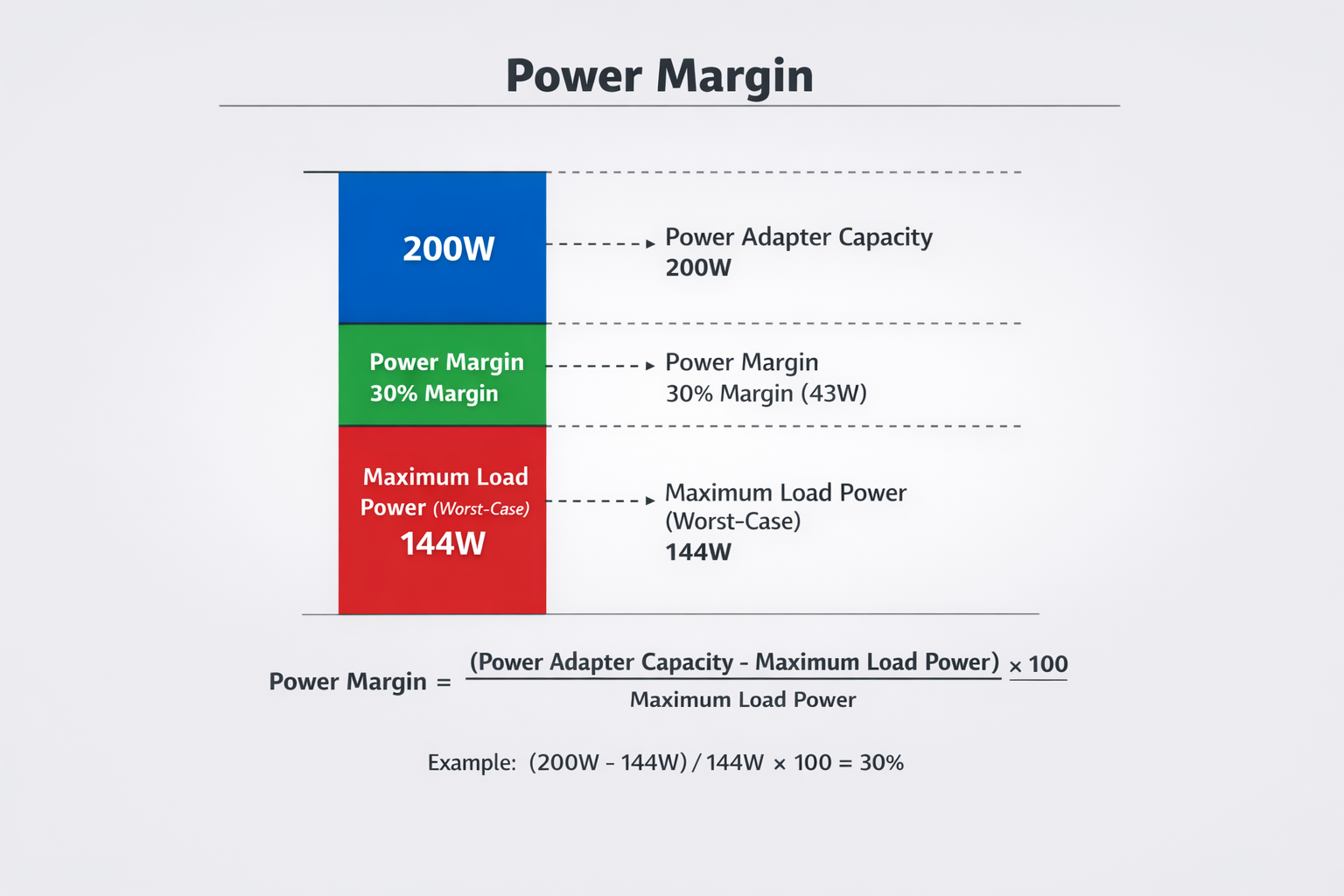
Maximum Load Power (W) = Maximum Voltage × Maximum Current
Example:
- System voltage: 12V
- Peak current: 12A
Maximum load power = 144W
Power Margin = (Adapter Capacity – Max Load) ÷ Max Load × 100
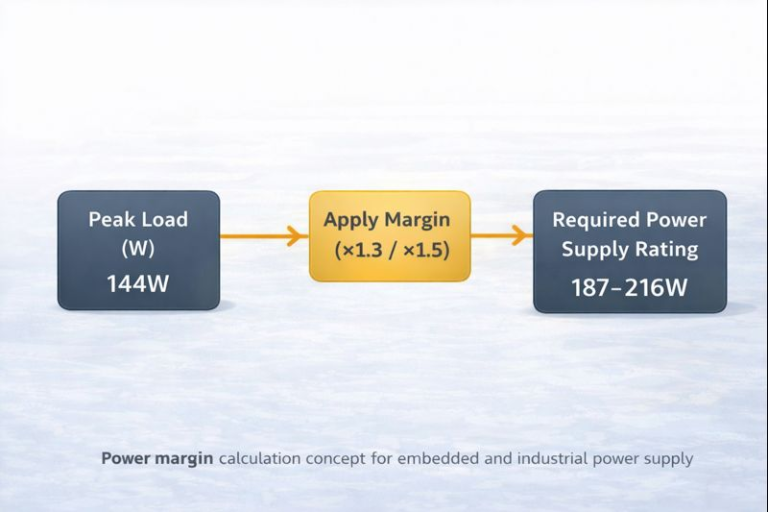
Step 2: Apply Recommended Margin
A common engineering guideline:
- 20–30% margin for general embedded systems
- 30–50% margin for industrial or high-reliability systems
Using a 30% margin:
Required Power = 144W × 1.3 ≈ 187W
In this case, a 200W or higher power supply would be appropriate.
For systems requiring around 200W, our 120W AC-DC power adapter series provides reliable high-margin operation.
Step 3: Consider Multi-Voltage / Multi-Stage Systems
If your design uses AC-DC → DC-DC stages:
Example: AC-DC adapter output may be sufficient, but downstream DC-DC converters could still be overloaded if margin is ignored.
Evaluate margin at each stage
Include voltage drops and efficiency losses
For understanding how to choose between AC-DC and DC-DC stages when calculating power margin, see our detailed technical guide.
5. Factors That Increase Required Power Margin
Power margin is not a fixed number. It depends on system conditions.
5.1 Temperature Effects
Power supply output capability often decreases at elevated temperatures.
Derating curves must be considered, especially in enclosed systems.
5.2 Aging and Component Degradation
Capacitors and magnetic components degrade over time, reducing available power.
Designing with insufficient margin shortens system lifespan.
5.3 Load Transients
DC-DC converters, CPUs, and communication modules can draw short bursts of high current that exceed steady-state values.
Ignoring transient behavior leads to instability and resets.
6. Power Margin in Multi-Stage Power Architectures
In systems using both AC-DC and DC-DC stages:
- Margin must be evaluated at each stage
- Losses between stages must be included
For example:
- AC-DC output margin may be sufficient
- But downstream DC-DC converters may still be overloaded
This is why margin calculation must follow the actual power architecture, not just the input supply.
7. Common Power Margin Mistakes
- Using nominal current instead of peak current
- Ignoring temperature derating
- Oversizing the AC-DC supply but undersizing DC-DC converters
- Assuming margin equals reliability without considering layout and thermal design
8. Practical Recommendations
- Start margin calculations early in the design phase
- Base calculations on worst-case conditions, not typical usage
- Review margin again after layout, thermal, and EMC changes
- Treat power margin as part of system reliability, not a standalone number
A well-designed power margin strategy is one of the simplest ways to improve long-term system stability.
How to Choose AC-DC vs DC-DC in Embedded Systems, please refer: https://xjkadapter.com/how-to-choose-ac-dc-vs-dc-dc-power-supplies-in-embedded-and-industrial-systems/ .