A Practical Guide for OEM Buyers and Industrial Equipment Manufacturers
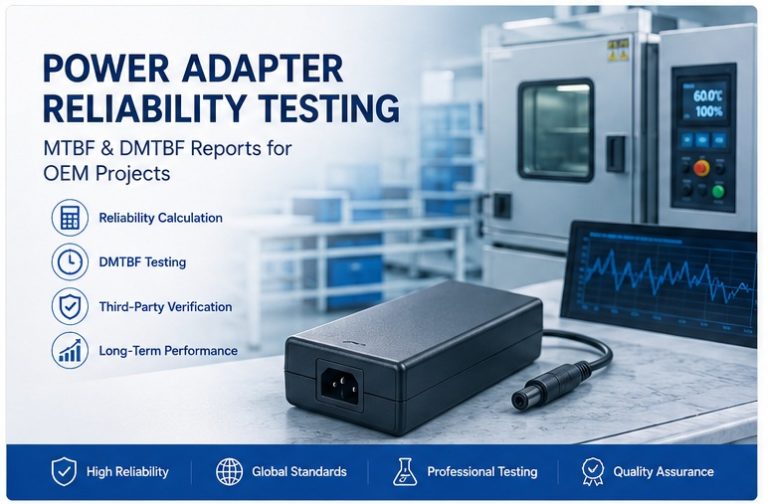
When sourcing a power adapter for industrial, medical, networking, or other mission-critical equipment, buyers are often asked to specify whether an MTBF (Mean Time Between Failures) or DMTBF (Demonstrated Mean Time Between Failures) report is required.
At first glance, these two terms appear similar. However, they represent different approaches to evaluating product reliability, and the required testing methods, costs, and lead times can vary significantly.
Many OEM buyers request an “MTBF report” simply because it appears on their supplier checklist, while others require a third-party DMTBF report to satisfy customer specifications, regulatory documentation, or internal qualification procedures.
Understanding the difference before placing an order can help you:
- Select the appropriate reliability verification method
- Avoid unnecessary testing costs
- Reduce project lead time
- Ensure the final report meets your customer’s actual requirements
In this guide, we’ll explain how MTBF and DMTBF reports are generated, when each is appropriate, what affects testing costs, and how manufacturers typically support OEM projects requiring customized reliability verification.
Why Do Customers Request MTBF or DMTBF Reports?
Many engineers assume that MTBF reports are simply another technical document. In reality, they are usually requested because the end application demands evidence of long-term reliability, not because the customer wants to study reliability theory.
For OEM projects, the request often originates from the customer’s own client, certification body, or quality management system. In other words, your direct customer may simply be passing the requirement down the supply chain.
Typical situations include:
Industrial Automation Equipment
Power supplies used in factory automation systems are expected to operate continuously for many years with minimal downtime. Buyers often request reliability documentation as part of supplier qualification.
Medical Devices
Although medical power supplies must comply with standards such as IEC 60601-1, some manufacturers also request MTBF or DMTBF information to support product reliability assessments and internal risk management.
Telecommunications & Networking Equipment
Communication infrastructure frequently operates 24 hours a day. Reliability calculations are commonly included during product design and vendor evaluation.
Transportation & Railway Systems
Equipment installed in transportation applications often requires higher reliability documentation because maintenance opportunities are limited and service interruptions can be costly.
Government or Enterprise Procurement
Some procurement specifications explicitly require suppliers to provide reliability reports as part of the technical submission package.
It is important to understand that not every project requires the same type of reliability report.
Some customers simply need an MTBF calculation generated according to an accepted reliability prediction standard. Others require a demonstrated reliability report based on laboratory testing under specified operating conditions.
Clarifying this requirement at the beginning of a project can save both time and unnecessary testing expenses later.
MTBF vs. DMTBF: What’s the Difference?
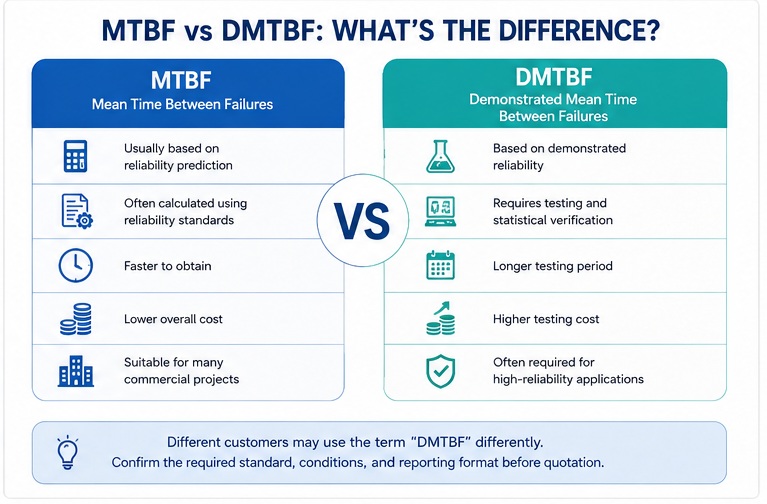
Although the two terms are frequently used together, MTBF and DMTBF are not interchangeable.
The biggest difference lies in how reliability is demonstrated.
| MTBF | DMTBF |
|---|---|
| Mean Time Between Failures | Demonstrated Mean Time Between Failures |
| Usually based on reliability prediction models | Based on demonstrated statistical evidence |
| Often generated through engineering calculation | Requires testing and statistical verification |
| Faster to obtain | Longer testing period |
| Lower overall cost | Higher testing cost |
| Suitable for many commercial projects | Often required for high-reliability applications |
For many commercial power adapters, an MTBF value is calculated using internationally recognized reliability prediction standards together with component failure-rate databases.
A DMTBF report, however, generally requires laboratory testing or demonstrated reliability analysis under defined operating conditions, such as:
- Ambient temperature
- Output load
- Operating duration
- Confidence level
- Statistical evaluation method
Because different laboratories and industries may define DMTBF requirements differently, buyers should avoid assuming that every “DMTBF report” follows the same methodology.
Before providing a quotation, manufacturers typically need to confirm:
- Which reliability standard should be used?
- Is calculation acceptable, or is demonstrated testing required?
- What operating conditions must be applied?
- Is a third-party laboratory report mandatory?
- What confidence level is specified?
These details have a direct impact on both project cost and delivery schedule.
How Is an MTBF Report Generated?
One of the most common misconceptions is that an MTBF value is obtained by operating a power adapter continuously until it fails.
In reality, many MTBF reports are generated through engineering reliability prediction rather than long-term endurance testing.
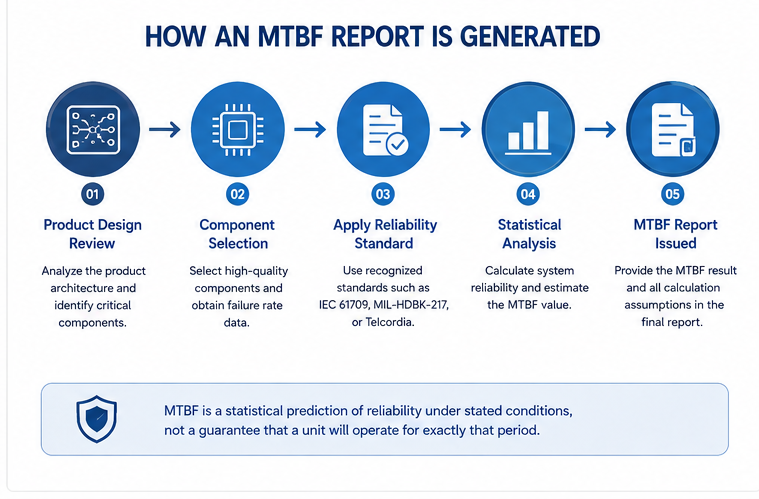
The process typically follows these steps:
Step 1 — Product Design Review
Engineers first identify the electrical architecture of the power adapter, including major functional blocks and critical components.
Step 2 — Component Selection
Each component—such as electrolytic capacitors, MOSFETs, transformers, optocouplers, ICs, and connectors—has an expected failure rate based on historical reliability data.
The quality of these components has a significant influence on the calculated MTBF value.
Step 3 — Apply a Reliability Prediction Standard
The component failure data is then analyzed using an established reliability prediction methodology.
Commonly used standards include:
- IEC 61709 – Widely adopted for electronic equipment reliability prediction.
- MIL-HDBK-217 – Historically used in military and industrial electronic applications.
- Telcordia SR-332 – Frequently applied in telecommunications equipment.
Different customers may specify different standards depending on their industry or internal engineering requirements.
Step 4 — Calculate System Reliability
Using statistical models, engineers combine the predicted failure rates of all major components to estimate the overall reliability of the complete power adapter.
The resulting MTBF value is expressed in operating hours.
Step 5 — Issue the MTBF Report
The final report generally includes:
- Product identification
- Applied reliability standard
- Environmental assumptions
- Operating conditions
- Calculation methodology
- Estimated MTBF result
It is important to remember that an MTBF value is a statistical reliability prediction—not a guarantee that an individual power adapter will operate for exactly that number of hours.
Instead, it provides engineers and purchasers with a standardized method for comparing the expected reliability of different products under defined conditions.
When Is DMTBF Testing Required?
Not every power adapter project requires a demonstrated MTBF (DMTBF) test. In many commercial applications, an engineering MTBF calculation is sufficient to support product documentation and supplier evaluation.
However, certain industries and customers require demirical reliability verification rather than prediction alone. In these situations, a DMTBF report may be specified as part of the purchasing requirements or qualification process.
Typical scenarios include:
Industrial Automation Equipment
Industrial control systems, PLCs, machine vision equipment, and factory automation devices often operate continuously in demanding environments. Some manufacturers require demonstrated reliability data to support long-term maintenance planning and supplier qualification.
Medical Equipment
Medical device manufacturers may request additional reliability evidence beyond electrical safety certification, particularly during internal product validation or regulatory documentation preparation.
Depending on the project, the required report may specify operating conditions, confidence levels, or third-party laboratory verification.
Railway and Transportation Systems
Power supplies used in transportation applications are expected to maintain stable operation over extended service periods. Reliability verification helps reduce maintenance risks and supports long-term operational planning.
Telecommunications Infrastructure
Telecommunication systems often run 24 hours a day throughout the year. For network operators, demonstrated reliability can be an important factor when evaluating equipment suppliers.
Mission-Critical Applications
Any equipment where unexpected downtime could result in significant financial loss or operational disruption may require higher levels of reliability verification.
Examples include:
- Industrial servers
- Data acquisition systems
- Edge computing devices
- Security monitoring systems
- Critical communication equipment
Although the exact requirements differ between industries, customers typically specify several key testing parameters before DMTBF verification begins.
These may include:
- Ambient operating temperature
- Output load percentage
- Continuous operating duration
- Required MTBF target
- Statistical confidence level
- Applicable reliability standard
For this reason, manufacturers should always confirm the customer’s detailed testing specification before preparing a quotation.
Why Does DMTBF Testing Take So Long?
One of the most common questions buyers ask is:
“If the required DMTBF is 100,000 hours, does the laboratory actually test the product for more than 11 years?”
Fortunately, the answer is No.
Modern reliability testing relies on statistical methods and accelerated life testing techniques rather than waiting for products to fail under normal operating conditions.
Instead of operating a power adapter continuously for many years, laboratories increase environmental stress under carefully controlled conditions to accelerate the aging process.
Common stress factors include:
- Elevated ambient temperature
- Higher operating load
- Continuous full-load operation
- Long-duration burn-in testing
The collected failure data is then analyzed using recognized statistical models and reliability prediction methods to estimate long-term performance under normal operating conditions.
Depending on the project, laboratories may use approaches based on:
- Accelerated Life Testing (ALT)
- Arrhenius acceleration models
- Reliability statistics
- Applicable international standards
This allows reliability engineers to estimate a product’s demonstrated reliability within a practical testing period instead of waiting decades for natural failures to occur.
The actual testing duration depends on many factors, including:
| Factor | Influence on Testing Time |
|---|---|
| Required MTBF target | Higher targets generally require more evidence |
| Number of test samples | More samples improve statistical confidence |
| Test temperature | Higher temperatures may accelerate aging |
| Operating load | Full-load testing often increases stress |
| Confidence level | Higher confidence requires more data |
| Test methodology | Different standards use different statistical approaches |
As a result, DMTBF projects may require anywhere from several weeks to several months depending on the customer’s specification.
What Factors Affect the Cost of an MTBF or DMTBF Report?
Many buyers are surprised to discover that reliability reports can vary significantly in price.
The reason is simple: the report itself is inexpensive—the testing and engineering work behind it are not.
Several technical factors influence the overall project cost.
Required Testing Standard
Different customers may require compliance with different reliability standards or industry-specific methodologies. Some standards involve more extensive calculations or additional verification work.
Testing Method
A calculation-based MTBF report is generally less expensive than a demonstrated reliability test because it does not require extended laboratory operation.
DMTBF verification typically involves test planning, laboratory resources, statistical analysis, and formal reporting.
Sample Quantity
Reliability testing usually requires multiple samples.
Increasing the sample size improves statistical confidence but also increases testing cost.
Operating Conditions
Customers may specify:
- Full-load operation
- Elevated temperature
- Continuous operation
- Customized environmental conditions
More demanding test conditions generally require additional laboratory resources.
Required Confidence Level
A higher confidence level requires more testing data before the laboratory can demonstrate that the required reliability target has been achieved.
Third-Party Laboratory Requirements
Some customers require reports issued by specific accredited laboratories.
Laboratory pricing, scheduling, and reporting formats can differ considerably.
For this reason, two projects requesting an “MTBF report” may have very different quotations once the detailed testing requirements are confirmed.
Why We Recommend Sample Verification Before Reliability Testing
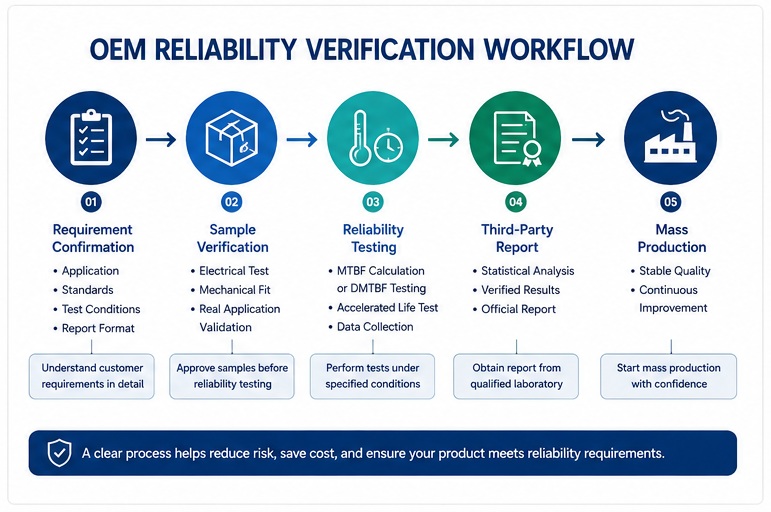
For customized OEM power adapter projects, reliability testing is usually one of the final validation steps—not the first.
Before arranging third-party MTBF or DMTBF testing, we generally recommend providing functional samples for customer evaluation.
This allows both parties to confirm that the product fully meets the project requirements, including:
- Output voltage and current
- Connector compatibility
- Mechanical dimensions
- Cable configuration
- Electrical performance
- Real application compatibility
Completing this verification first offers several important advantages:
- Avoid repeating expensive laboratory testing due to design changes
- Reduce project risk before formal reliability verification
- Confirm product functionality under actual operating conditions
- Shorten the overall project schedule
Once the sample has been approved, the manufacturer and customer can finalize the testing specification and arrange the appropriate reliability verification with a qualified third-party laboratory if required.
For OEM projects, this staged approach is often the most efficient and cost-effective way to complete both product validation and reliability documentation.
Which Reliability Verification Is Right for Your Project?
| Your Requirement | Recommended Solution |
|---|---|
| General commercial application | MTBF calculation |
| Customer only asks for an MTBF value | MTBF calculation based on IEC 61709 or equivalent |
| Customer specifies DMTBF with defined test conditions | Third-party DMTBF testing |
| Medical or industrial OEM project with qualification requirements | Confirm testing standard before quotation |
| Customized product under development | Verify samples before arranging reliability testing |