1. Supporting Sensitive ECG Signal Acquisition Electronics
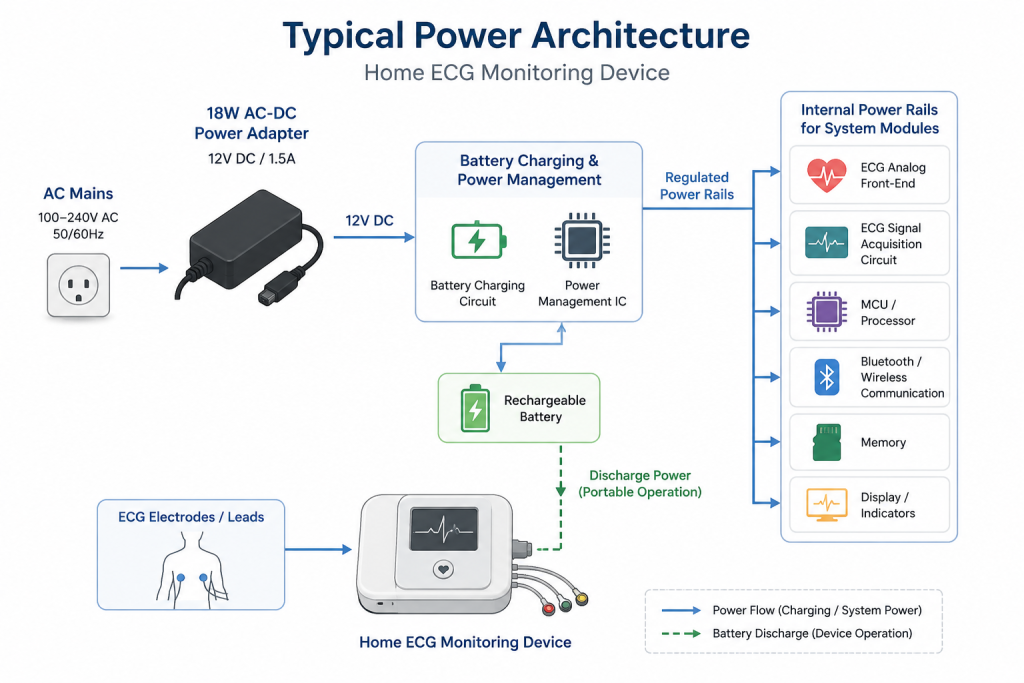
An ECG monitoring device may include sensitive analog circuitry used to acquire low-level bioelectrical signals from the patient.
A typical ECG signal acquisition architecture can include:
- ECG electrodes or leads
- Analog front-end circuitry
- Signal amplification
- Filtering
- Analog-to-digital conversion
- Digital signal processing
The power architecture therefore needs to support reliable operation of the complete monitoring system while minimizing unwanted electrical interference within the final device.
The external adapter should not be evaluated solely according to output voltage and power rating. The complete power architecture, including battery operation, internal DC-DC conversion, PCB design, grounding, filtering, cable configuration, and enclosure design, can influence overall system performance.
2. Patient-Connected Electrical Safety Considerations
ECG monitoring devices may use electrodes or other components connected to the patient.
Because of this, the electrical safety architecture of the complete device requires careful evaluation.
Depending on the final product design, important considerations can include:
- Isolation
- Leakage current
- Applied-part classification
- Patient protection requirements
- Creepage and clearance distances
- Applicable medical electrical safety standards
The external power supply should therefore be evaluated as part of the complete electrical safety architecture rather than as an isolated component.
The final requirements depend on the intended use and design of the finished medical device.
3. Battery Charging and Portable Operation
Portable ECG monitoring devices are often designed to operate from an internal rechargeable battery.
In this architecture, the external AC-DC adapter may primarily provide power for:
- Charging the internal battery
- Supporting the device while charging
- Supplying the internal power management circuit
This differs from a continuously powered desktop monitoring system.
The adapter therefore needs sufficient output capacity to support the battery charging requirements while also allowing the system to operate normally when required.
The appropriate adapter rating should consider:
- Battery capacity
- Charging current
- Charging time
- System power consumption
- Operation during charging
- Internal conversion losses
4. EMC and Electrical Noise Considerations
ECG monitoring systems may include both sensitive signal acquisition circuits and wireless communication functions.
The complete electrical design therefore needs to consider electromagnetic compatibility and unwanted electrical interference.
Important considerations include:
- Conducted emissions
- Radiated emissions
- Switching noise
- Output ripple and noise
- Input filtering
- Output filtering
- DC cable configuration
- Wireless communication interference
The power adapter should be evaluated together with the final device because system-level EMC performance can be affected by the adapter, cable, enclosure, internal electronics, grounding, and overall product configuration.
5. Compact Design for Home Use
The final product was intended for convenient use in home healthcare environments.
The external adapter therefore needed to provide adequate output capacity while maintaining a compact and practical form factor.
Important requirements included:
- Compact dimensions
- Lightweight construction
- Easy handling
- Convenient storage
- Flexible regional plug options
- Appropriate DC cable configuration
A compact external power solution can also help keep the ECG monitoring device itself smaller and easier to use.