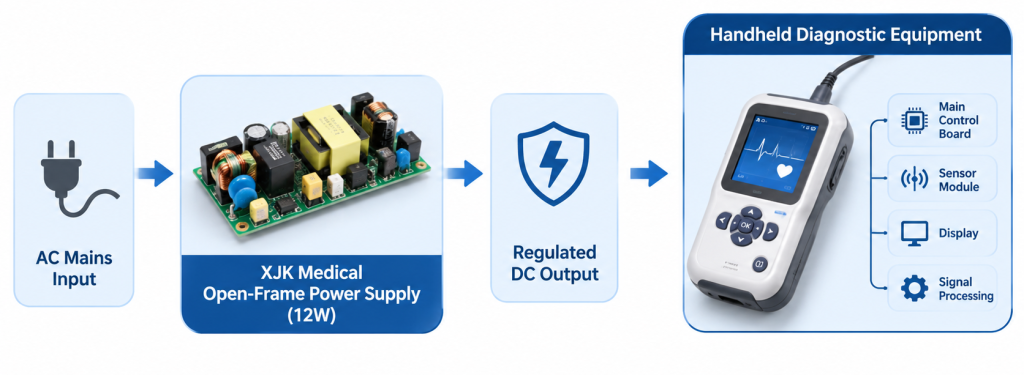
Integrating a power supply into compact handheld diagnostic equipment involves more than selecting a suitable wattage. The power solution must meet the device’s mechanical, electrical, and safety requirements while operating reliably within a limited enclosure.
Several key engineering considerations need to be addressed during the development process.
1. Limited Internal Installation Space
Handheld diagnostic devices require compact internal layouts to accommodate electronic components, sensors, displays, and other functional modules.
An oversized power supply can restrict PCB placement and increase the overall enclosure dimensions.
The customer therefore needed a compact open-frame power configuration that could be integrated directly into the equipment without compromising the available space for other electronic components.
2. Medical Electrical Safety Requirements
Medical electrical equipment requires careful consideration of electrical safety, isolation, and leakage current.
The power supply must be evaluated in relation to the intended medical equipment classification, applied parts, means of protection, and system-level safety requirements.
A suitable power solution should therefore support the manufacturer’s IEC 60601-1 compliance evaluation rather than relying solely on conventional industrial or consumer power supply specifications.
3. Stable Power for Sensitive Diagnostic Electronics
Handheld diagnostic equipment may contain sensors, embedded processors, display circuits, and signal processing components.
These electronic circuits require a stable DC power source with appropriate ripple and noise performance.
Poorly controlled power fluctuations or conducted noise may interfere with sensitive electronic circuits and affect overall system performance.
The power supply must therefore be evaluated for output regulation, ripple and noise, and compatibility with the equipment’s electronic architecture.
4. Thermal Management in Compact Enclosures
Unlike larger electronic systems, handheld diagnostic devices have limited internal space for airflow and heat dissipation.
The power supply’s conversion efficiency, component temperature rise, and surrounding installation conditions can all influence the thermal performance of the complete device.
A suitable embedded power solution must therefore consider thermal management under the equipment’s intended operating conditions.