GaN vs Silicon Power Adapters: Efficiency, Thermal & Cost Comparison for OEM Design
As power adapter technology evolves, Gallium Nitride (GaN) has emerged as a game-changing alternative to traditional silicon (Si). This article explores how GaN and silicon differ in efficiency, size, heat generation, and overall performance — and explains why GaN power adapters are quickly becoming the preferred choice for modern electronics.
Introduction
In recent years, the demand for smaller, faster, and more efficient power adapters has accelerated. From laptops and smartphones to medical and industrial devices, manufacturers are pushing the limits of power density and energy efficiency. Traditionally, silicon-based power adapters have dominated the market. However, the rise of GaN (Gallium Nitride) technology has introduced a new era of compact, high-performance adapters that deliver more power with less heat and space.
This article explores the key differences between GaN and silicon power adapters, focusing on efficiency, size, performance, and reliability—and what these differences mean for OEMs designing next-generation devices.
What Are GaN and Silicon Power Adapters?
Silicon Power Adapters
Silicon-based semiconductors have been the foundation of power electronics for decades. They are reliable, mature, and relatively inexpensive to manufacture. However, silicon transistors have inherent physical limits in terms of switching speed, thermal resistance, and power density.
GaN (Gallium Nitride) Power Adapters
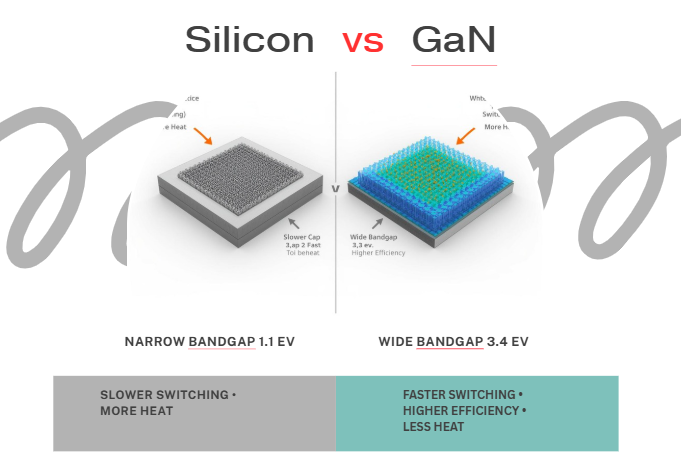
GaN is a wide bandgap semiconductor that allows much higher voltage and frequency operation compared to silicon. This means less energy loss, faster switching, and reduced heat generation—all leading to smaller, more efficient power supplies.
✅ Key takeaway: GaN adapters use smaller components and can handle higher power output without overheating, making them ideal for compact and high-performance OEM designs.
Comparison of GaN and Silicon semiconductor structures in power adapters
Efficiency Comparison
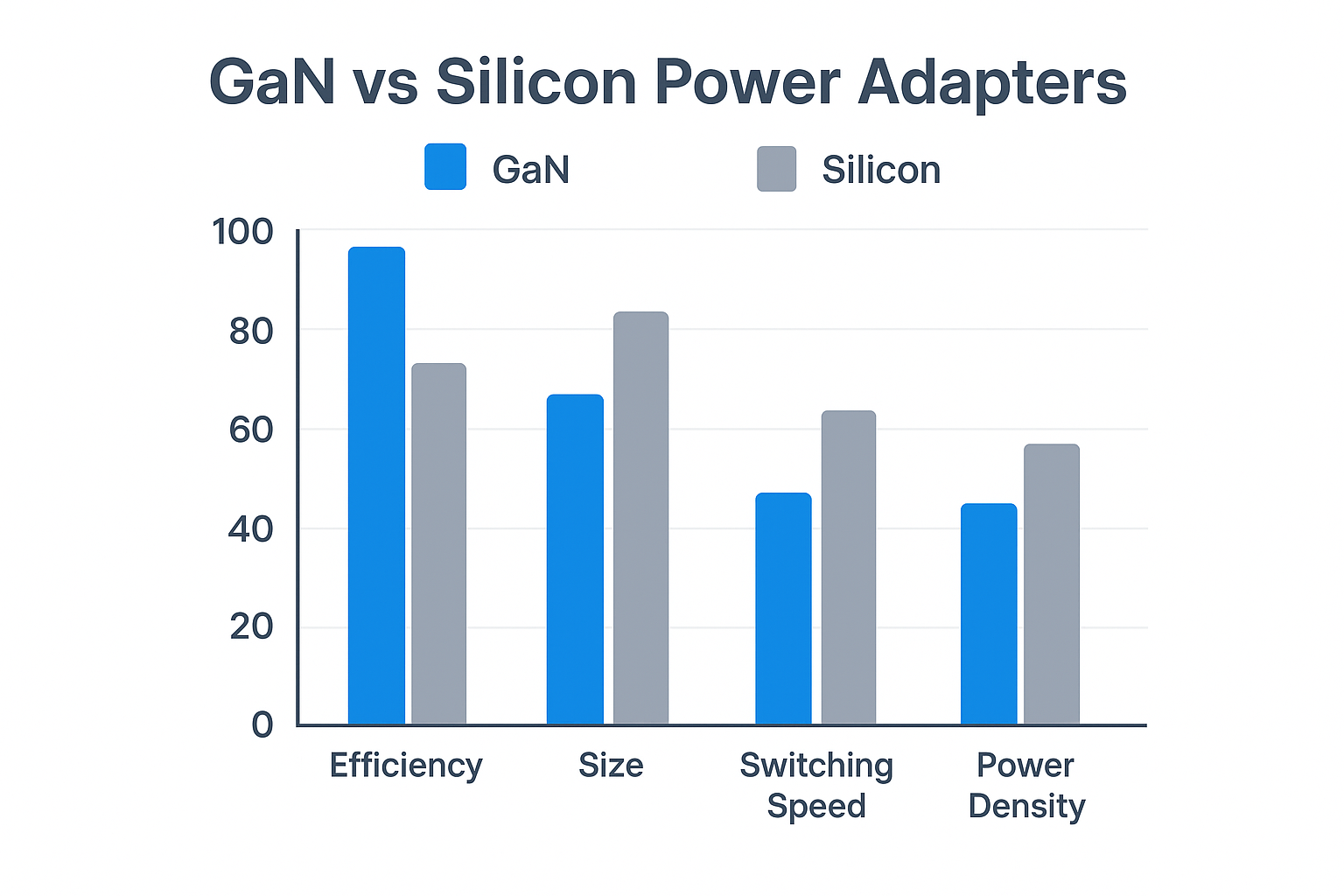
When it comes to energy conversion, efficiency is the defining advantage of GaN. Traditional silicon power supplies typically operate at 85–90% efficiency, while GaN-based designs can achieve up to 95% or higher.
Feature
GaN Power Adapter
Silicon Power Adapter
Switching Frequency
Up to 1 MHz
Typically < 200 kHz
Power Efficiency
93–96%
85–90%
Heat Generation
Low
Moderate to High
Energy Standards Compliance
Easily meets DOE Level VI / CoC Tier 2
May require design optimization
These gains translate to less energy loss, reduced heat, and longer lifespan—key benefits for medical power supplies and high-performance consumer devices.
High-efficiency GaN power adapter with energy flow visualization
Size and Design Differences
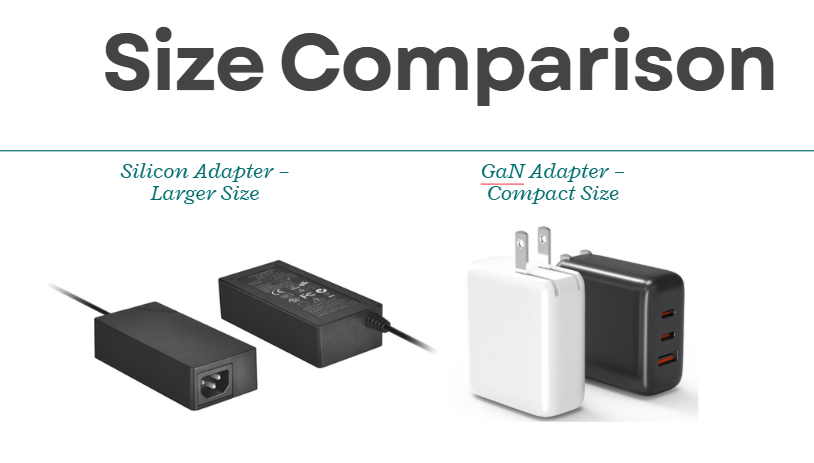
One of GaN’s biggest strengths is miniaturization. Because GaN can operate at higher frequencies, it allows designers to use smaller transformers, inductors, and capacitors, leading to drastically reduced adapter sizes.
GaN adapters are typically 30–50% smaller and lighter than equivalent silicon models.
Compact size allows for sleeker OEM device designs and portability advantages.
In medical applications, smaller adapters improve usability and integration flexibility.
✅ In summary: GaN enables higher power output in smaller enclosures, ideal for compact consumer electronics and medical equipment.
GaN adapter vs sillion adapter
Performance and Reliability
Beyond efficiency and size, performance and reliability play critical roles in choosing between GaN and silicon.
GaN Advantages
High power density
Faster switching response
Lower thermal stress
Longer operational lifespan
Silicon Advantages
Proven long-term reliability
Lower production cost
Simpler manufacturing process
In demanding OEM applications—such as patient monitoring systems, fast chargers, and industrial automation—GaN offers measurable performance advantages while maintaining safety and compliance.
Efficiency and thermal performance comparison between GaN and Silicon power adapters
Cost and Market Adoption
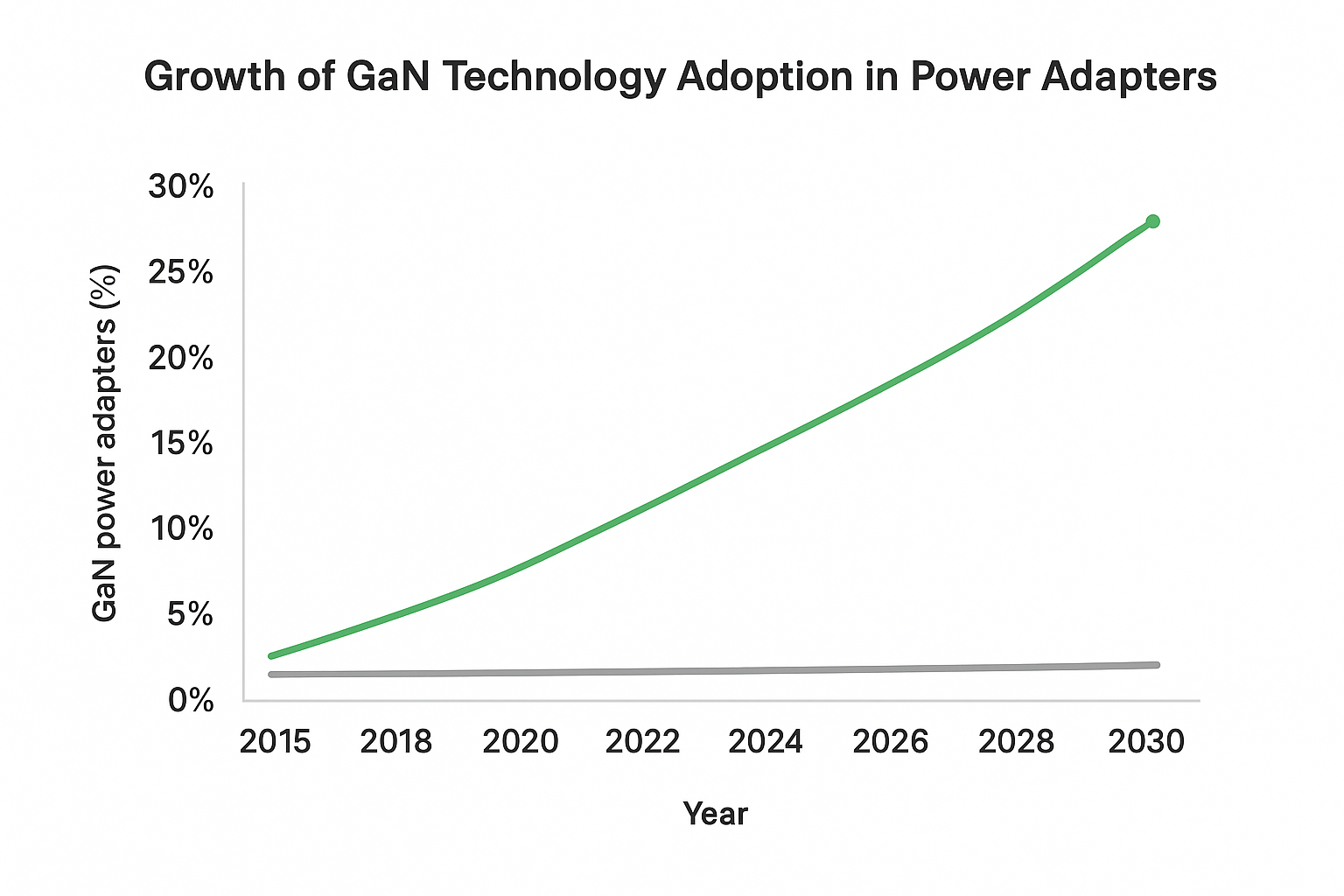
Historically, GaN technology was considered more expensive. However, manufacturing costs have fallen significantly due to large-scale production and design standardization.
Current status: GaN adapters may still cost slightly more, but the total cost of ownership is often lower thanks to higher energy efficiency and durability.
Market trend: Major OEMs and charger brands are adopting GaN rapidly, especially for high-wattage adapters (65W–240W).
Future direction: Expect GaN to dominate fast-charging, industrial, and medical power applications within the next few years.
Future of Power Adapter Technology
The next generation of power adapters will combine GaN technology with intelligent power management to deliver adaptive, high-efficiency solutions.
Key trends include:
Integration of smart control ICs for adaptive voltage and current regulation.
AI-based power optimization to improve energy use and battery health.
High-wattage OEM solutions supporting 120W+ for advanced devices.
Improved compliance with safety standards such as IEC60601-1 for medical applications.
At the forefront of this evolution, XJK Power continues to design custom GaN OEM power adapters that meet the highest standards of efficiency, reliability, and safety for global clients.
When Should OEMs Choose GaN?
Choosing between GaN and traditional silicon technology depends on the application’s power requirements, product size constraints, thermal performance, and cost targets.
For many OEM projects, GaN is not simply a technology upgrade—it is a design advantage that enables more compact products with improved energy efficiency.
Application Requirement
GaN Recommended
Reason
Compact product design
✅ Yes
Smaller magnetic components allow a more compact adapter.
High power output (65W–240W)
✅ Yes
Higher efficiency and power density reduce heat generation.
GaN offers efficiency benefits, while silicon may remain a cost-effective choice for fixed installations.
Low-power products below 30W
❌ Usually Not Necessary
Silicon solutions are often sufficient and more economical.
Key Considerations for OEM Designers
When evaluating GaN technology, OEM engineers should consider:
Required output power
Available installation space
Thermal management requirements
Energy efficiency regulations (DOE Level VI, CoC Tier 2)
Product lifecycle expectations
Manufacturing budget
Safety certification requirements
For products where compact size, thermal performance, and energy efficiency are priorities, GaN technology typically provides the best long-term value.
Which Devices Benefit Most from GaN?
Because of its high efficiency and compact design, GaN technology is increasingly used across a wide range of electronic devices.
USB-C Laptop Chargers
Modern laptops require high power while remaining portable. GaN adapters can deliver 65W, 100W, or even 140W in significantly smaller housings compared to traditional silicon adapters.
Portable Medical Devices
Portable patient monitors, diagnostic equipment, and mobile medical workstations benefit from smaller adapters with lower operating temperatures and improved energy efficiency.
Portable Displays and Docking Stations
Portable monitors and USB-C docking stations often require compact power solutions for travel and mobile work environments. GaN technology helps reduce adapter size without sacrificing performance.
Professional Tablets and Mobile Workstations
Industrial tablets, rugged tablets, and mobile workstations frequently operate in space-limited environments where lightweight, high-efficiency power adapters are preferred.
High-Power Consumer Electronics
Gaming handhelds, premium tablets, professional cameras, portable projectors, and other high-performance portable electronics increasingly adopt GaN power adapters to reduce charging time while minimizing adapter size.
Typical GaN Power Adapter Applications
Device Category
Typical Power
Why GaN
USB-C Laptop Chargers
65W–140W
High power density
Portable Medical Devices
60W–120W
Lower heat & compact size
Portable Monitors
45W–100W
Travel-friendly
Mobile Workstations
90W–120W
Smaller adapter
Professional Tablets
45W–100W
Efficient charging
Portable Projectors
65W–120W
Reduced enclosure size
Conclusion
The comparison between GaN and silicon power adapters clearly highlights a technological shift:
Category
GaN Power Adapter
Silicon Power Adapter
Efficiency
Higher (up to 96%)
Lower (85–90%)
Size
Smaller, lighter
Larger
Heat
Less heat
More heat
Cost
Slightly higher
Lower
Best Use
High-performance OEM & medical
Cost-sensitive designs
GaN offers superior efficiency, compact size, and performance, making it the preferred choice for next-generation consumer and medical devices. While silicon remains a cost-effective solution for standard applications, GaN represents the future of OEM power technology.
Contact XJK Power for OEM GaN Solutions
At Shenzhen Xinjukang Technology (XJK Power) Co., Ltd., we specialize in custom GaN-based OEM power adapters for consumer electronics, industrial equipment, and medical devices.
Our engineering team develops power supplies that meet the latest energy efficiency standards (DOE VI, CoC Tier 2) and safety certifications.
1. Is a GaN power adapter better than a silicon power adapter?
GaN power adapters generally provide higher energy efficiency, smaller size, and lower operating temperatures than traditional silicon adapters. They are particularly advantageous for high-power applications above 65W where compact design and thermal performance are important.
2. Are GaN power adapters safe for OEM products?
Yes. When designed and manufactured in accordance with international safety standards, GaN power adapters are as safe and reliable as conventional silicon adapters. OEM products should also comply with the appropriate certifications, such as IEC 62368-1 or IEC 60601-1, depending on the application.
3. Why are GaN power adapters smaller?
GaN transistors switch at much higher frequencies than silicon devices. This allows designers to use smaller transformers, inductors, and capacitors, reducing the overall size and weight of the power adapter while maintaining high output power.
4. When should I choose a GaN power adapter instead of silicon?
GaN is typically the better choice for applications requiring high efficiency, compact size, fast charging, or power outputs above 65W. Silicon remains a practical and cost-effective solution for many lower-power or cost-sensitive applications.
5. Can GaN technology be used in medical power supplies?
Yes. GaN technology can be incorporated into medical-grade power supplies that comply with standards such as IEC 60601-1. It is particularly suitable for portable medical devices where reduced heat generation and compact size are valuable advantages.
6. Does XJK Power provide custom GaN power adapter solutions?
Yes. XJK Power offers OEM and ODM GaN power adapter development, including custom electrical specifications, enclosure design, branding, connector options, and assistance with international safety certifications for global markets.
Looking for an OEM GaN Power Adapter Manufacturer?
As an experienced OEM/ODM power adapter manufacturer, XJK Power helps global equipment manufacturers develop compact, high-efficiency GaN power adapters for commercial, industrial, medical, and portable electronic devices.
Whether you require a standard USB-C PD charger or a fully customized AC/DC power solution, our engineering team can support your project from concept to mass production.
Our OEM Capabilities
Custom output voltage and current
USB-C PD 3.1 and programmable power profiles
20W–240W GaN power adapter development
Custom housing and branding
Worldwide safety certifications
Medical-grade power supply development
Interchangeable AC plug systems
Low MOQ and flexible OEM/ODM services
If you’re developing your next-generation electronic product, our engineers can recommend the most suitable power solution based on your technical requirements, certification needs, and target market.
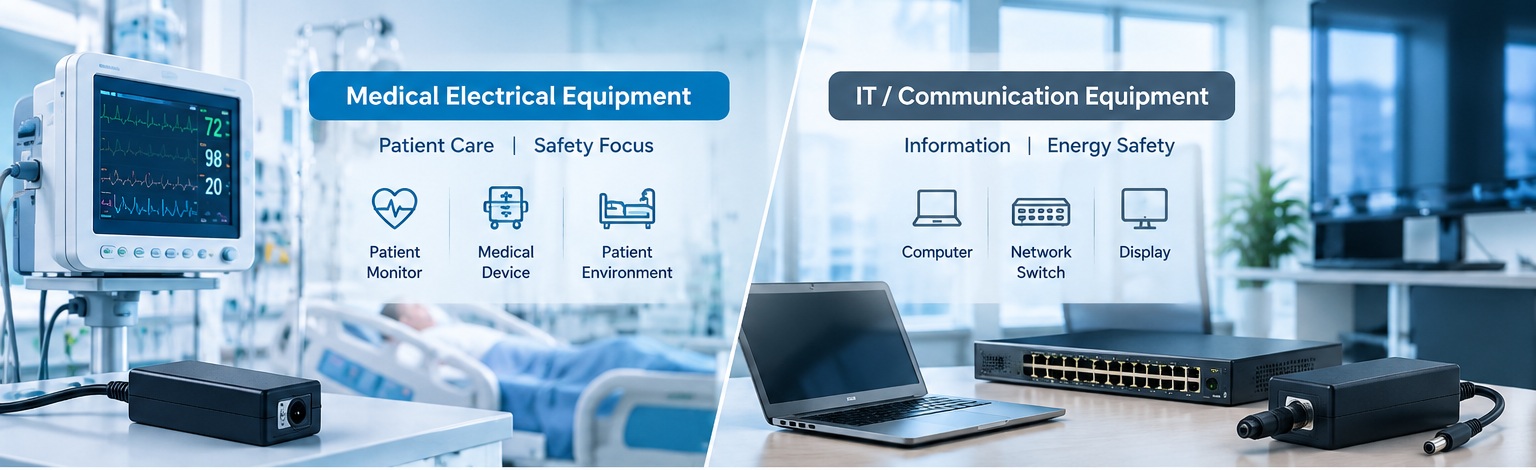
IEC 60601-1 and IEC 62368-1 follow different safety principles and apply to different equipment. This guide explains how intended use, patient protection, isolation, and leakage current affect standard selection and power supply requirements.
A medical equipment OEM needed a reliable power solution for a specialized diagnostic ultrasound system. XJK POWER provided a customized medical AC-DC power solution designed around the equipment’s safety, electrical and integration requirements.
Compact multi-parameter patient monitors are used for short-term and routine monitoring of patients in hospital wards, post-surgical recovery areas, outpatient settings, and other clinical environments. These systems typically monitor ECG, SpO₂, non-invasive blood pressure, respiration, temperature, and pulse rate in a single compact unit.