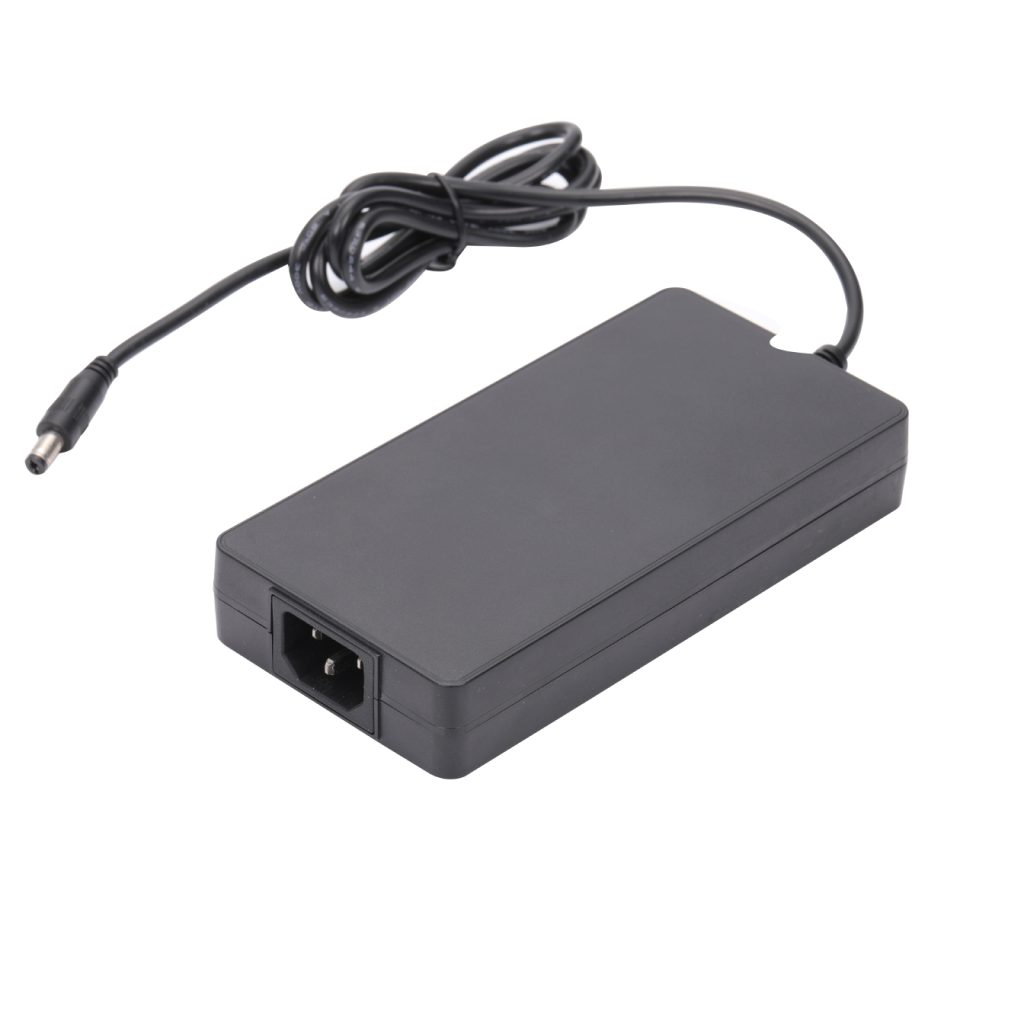
Case Study: 120W Power Adapter for Networking & Communication Devices (PoE Switch)
Explore a real-world case of a 120W 48V/54V power adapter for networking devices. See how it supports 4-port PoE+ switches, ensures stable operation, and meets efficiency and certification standards.
Introduction
As networking devices continue to evolve and expand their capabilities, Power over Ethernet (PoE) has become a standard solution for powering IP cameras, wireless access points, and industrial communication systems. This technology simplifies installation by delivering both data and power through a single Ethernet cable, reducing infrastructure complexity and installation costs.
Small to mid-sized PoE switches typically operate within a 100W–120W power range, making the 120W power adapter one of the most commonly used configurations in networking applications. This power level represents an optimal balance between capacity and efficiency for most commercial and industrial deployments.
However, choosing the wrong power adapter can lead to system instability, device rebooting, or insufficient power delivery — issues that can compromise network reliability and operational continuity. Inadequate power margins, thermal limitations, or voltage instability can result in intermittent failures that are difficult to diagnose and costly to resolve.
In this article, we explore a real-world case of a 4-port PoE+ switch and explain why a 120W 48V/54V power adapter is the optimal choice for reliable operation in demanding networking environments. We examine the technical requirements, power distribution mechanisms, and design considerations that make this configuration the industry standard for industrial networking solutions.
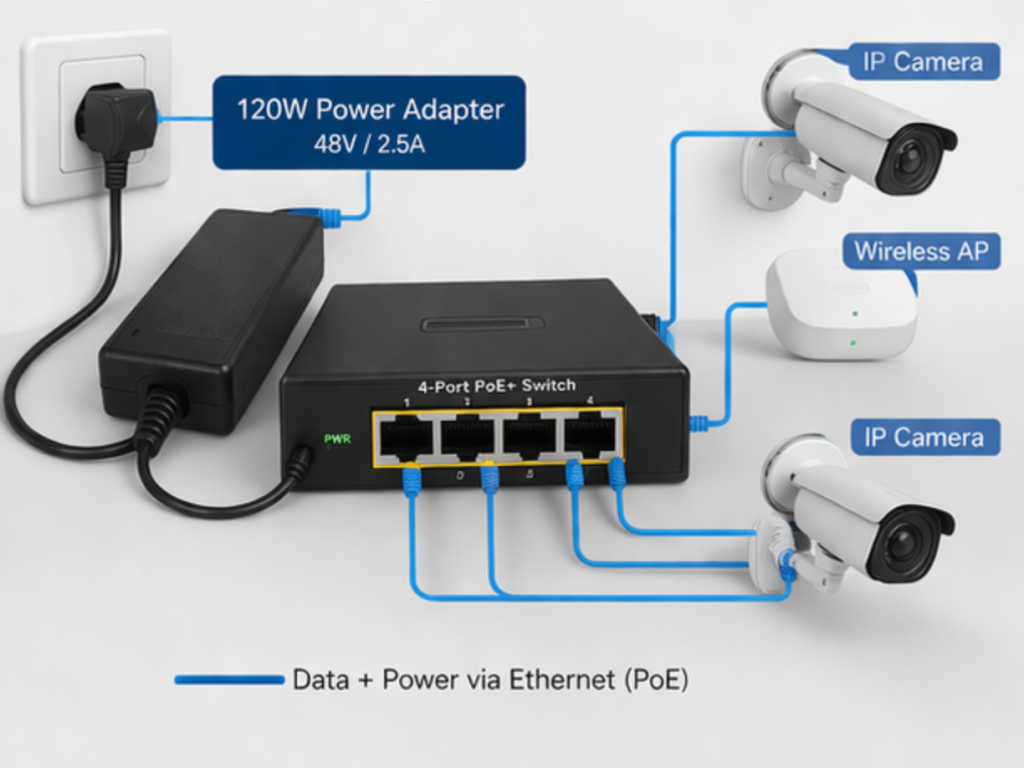
Typical Application: 4-Port PoE+ Switch
Device Overview
A 4-port Gigabit PoE+ switch is widely used in diverse networking applications across multiple industries:
IP surveillance systems for security monitoring
Wireless access point (AP) deployment for enterprise connectivity
Industrial networking environments requiring robust communication infrastructure
Smart building infrastructure integrating multiple IoT devices
Remote site installations where centralized power distribution is impractical
These switches provide both data and power through Ethernet cables, simplifying installation and reducing wiring complexity. This dual-function capability eliminates the need for separate power supplies at each endpoint, significantly reducing installation time and infrastructure costs while improving system reliability.
Power Requirement Breakdown
Each PoE+ port (IEEE 802.3at standard) can deliver up to 30W per port to connected devices.
The total power calculation for a fully loaded 4-port switch includes:
4 Ports × 30W = 120W total output for connected devices
Power conversion efficiency losses (typically 10-15%)
Thermal management overhead for sustained operation
👉 Conclusion: A 120W power adapter is required to support full-load operation without performance degradation. This capacity ensures that all four ports can simultaneously deliver maximum power while maintaining stable voltage regulation and thermal performance within acceptable operating parameters.
Input Voltage Requirement
Most PoE switches operate with standardized input voltages:
48V DC (standard PoE voltage)
or 54V DC (providing additional headroom for voltage drop compensation)
This voltage range ensures stable power delivery over Ethernet cables and complies with PoE standards established by IEEE 802.3af and 802.3at specifications. The higher voltage minimizes current requirements, reducing resistive losses in the Ethernet cables and improving overall system efficiency — particularly important for longer cable runs in industrial networking solutions.

Why a 120W Power Adapter Is Required
1. PoE Power Budget Mechanism
Unlike traditional devices that draw constant power, PoE switches use a power budget system that dynamically allocates available power based on connected device requirements.
The switch does not consume fixed power continuously
It dynamically distributes power to connected devices based on negotiated requirements
Power allocation occurs through the PoE detection and classification protocol
Unused power budget remains available for additional devices or future expansion
👉 A 120W switch means:
The total available output power is 120W, not constant consumption. The actual power draw varies based on the number and type of connected devices, their operational state, and their instantaneous power requirements.
2. Real-World Load Scenarios
Typical deployments in commercial and industrial environments include various device combinations:
4 × IP Cameras (20–25W each) for comprehensive surveillance coverage
2 × Wireless Access Points + 2 × IP Cameras for mixed connectivity and security
Mixed IoT devices including sensors, controllers, and communication modules
Industrial automation equipment requiring reliable continuous power
Building management systems integrating multiple subsystems
👉 Total power usage can easily reach 80W–110W under normal operating conditions, with peak demands approaching the full 120W capacity during simultaneous device initialization or high-activity periods.
3. Power Margin Requirement
To ensure long-term stability and reliable operation under varying load conditions, it is recommended:
Use a power adapter with at least 10–20% power margin above the maximum expected load.
This design margin prevents several critical issues:
Overloading that can trigger protection circuits or cause voltage sag
Thermal stress from continuous operation at maximum rated capacity
Reduced lifespan due to elevated component temperatures and stress
Voltage instability during load transients or device power-up sequences
Inadequate capacity for future system expansion or device upgrades
Operating a power adapter continuously at or near its maximum rated capacity significantly reduces reliability and accelerates component degradation. The power margin provides thermal headroom, allowing the adapter to operate at lower temperatures and higher efficiency, which directly translates to improved long-term reliability and extended operational lifespan.
Recommended 120W Power Adapter Specifications
When selecting a 120W power adapter for networking equipment and industrial networking solutions, the following specifications are critical for ensuring reliable operation, regulatory compliance, and long-term system stability.
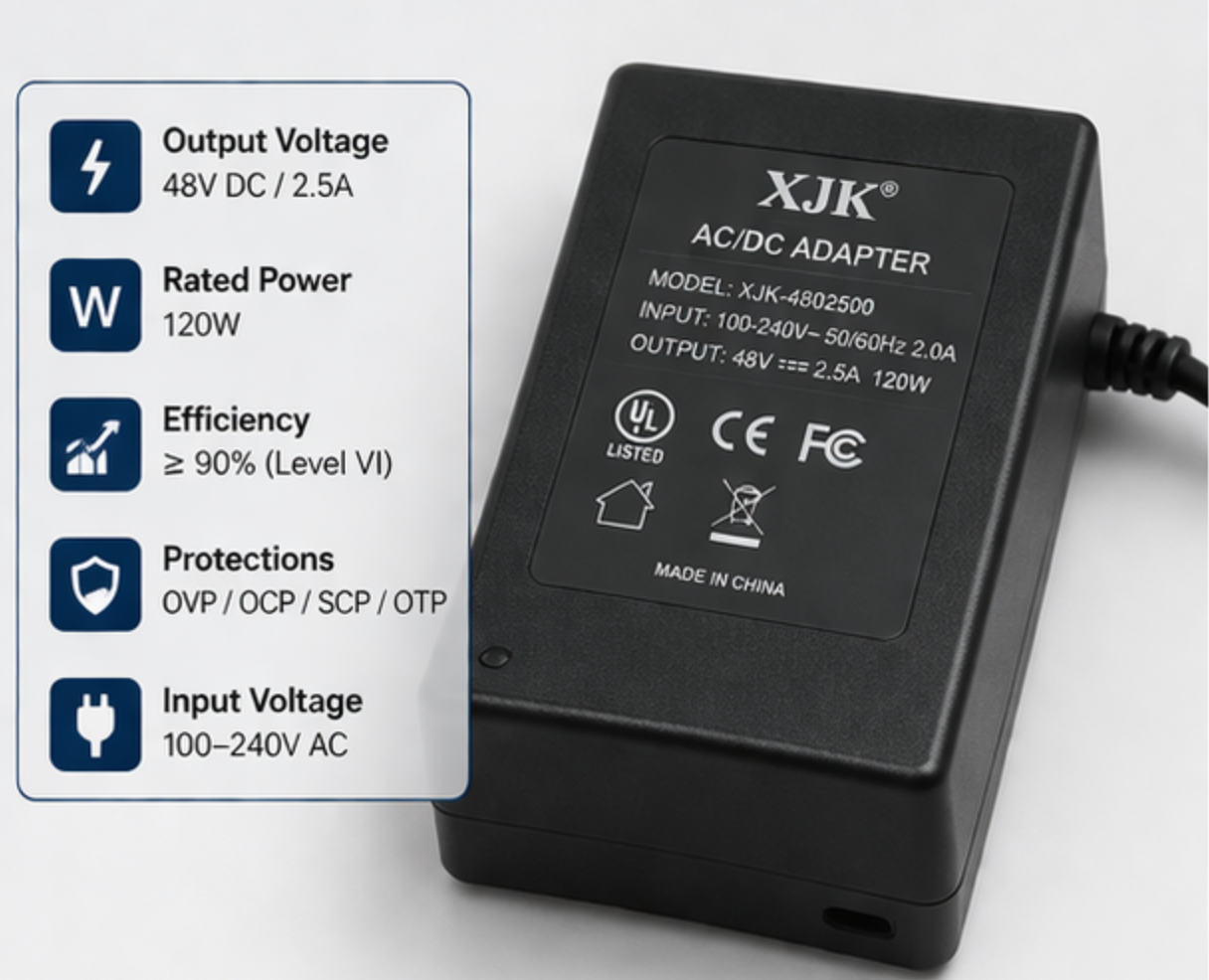
Output
The output specifications of a 120W power adapter for PoE networking applications must align precisely with the voltage and current requirements of the connected switch while providing adequate power delivery capacity for sustained operation.
48V / 2.5A (delivering 120W at standard PoE voltage)
or 54V / 2.22A (providing enhanced voltage headroom for extended cable runs)
👉 Optimized specifically for PoE applications and industrial networking solutions
The 48V output voltage represents the industry-standard PoE voltage specified in IEEE 802.3af and 802.3at standards, ensuring compatibility with the vast majority of PoE-enabled networking equipment deployed in commercial and industrial environments. The alternative 54V output provides additional voltage margin to compensate for resistive losses in longer Ethernet cable runs — particularly valuable in industrial installations where devices may be located at significant distances from the switch.
120W 48V power adapter for PoE switch
The current rating of 2.5A at 48V or 2.22A at 54V ensures that the 120W power adapter can deliver full rated power continuously without exceeding thermal design limits or triggering overcurrent protection mechanisms. This sustained power delivery capability is essential for networking equipment that operates 24/7 in mission-critical applications where downtime is unacceptable.
Input
Universal input voltage compatibility is a fundamental requirement for 120W power adapters deployed in diverse geographical locations and electrical infrastructure environments.
100–240V AC (providing global compatibility across all major power grids)
This wide input voltage range ensures that the same power adapter model can be deployed worldwide without modification, simplifying inventory management for system integrators and equipment manufacturers. The adapter automatically adjusts to the local mains voltage, whether operating on 100V systems common in Japan, 120V North American infrastructure, 230V European networks, or 240V systems found in many Asian and Pacific regions.
The universal input capability eliminates the need for voltage-specific models, reducing procurement complexity and enabling standardized deployments across international installations. For organizations managing industrial networking solutions across multiple facilities or countries, this standardization significantly simplifies logistics, reduces spare parts inventory requirements, and minimizes the risk of deploying incompatible equipment.
Efficiency
Energy efficiency is not merely an environmental consideration — it directly impacts operational costs, thermal management requirements, and long-term reliability in networking applications.
DOE Level VI compliant (meeting the most stringent international efficiency standards)
High efficiency (≥ 88–92% across typical load ranges)
DOE Level VI compliance represents the highest tier of energy efficiency standards established by the U.S. Department of Energy, ensuring minimal energy waste during AC-DC conversion. This certification is increasingly required for equipment sold in regulated markets and demonstrates commitment to sustainable engineering practices.
Operating efficiency in the 88–92% range means that only 8–12% of input power is dissipated as heat during the conversion process. This high efficiency translates directly to reduced thermal stress on internal components, lower cooling requirements, and decreased energy consumption over the adapter’s operational lifetime. For networking equipment operating continuously in data centers or industrial facilities, even small efficiency improvements can yield substantial energy cost savings and reduced cooling infrastructure requirements.
Protection Features
Comprehensive protection mechanisms are essential for safeguarding both the 120W power adapter and the connected networking equipment from electrical faults, transient events, and abnormal operating conditions.
Over Voltage Protection (OVP) — prevents damage from excessive output voltage
Over Current Protection (OCP) — limits current during overload conditions
Short Circuit Protection (SCP) — safely shuts down during output short circuits
Over Temperature Protection (OTP) — prevents thermal runaway and component damage
These integrated protection features form multiple layers of defense against common failure modes in power supply systems. OVP circuitry continuously monitors output voltage and triggers shutdown if voltage exceeds safe thresholds, protecting sensitive networking equipment from voltage spikes that could damage PoE-powered devices. OCP mechanisms limit current flow during overload conditions, preventing component stress and potential fire hazards while allowing the system to recover gracefully when normal conditions resume.
SCP provides critical protection during installation errors or cable damage scenarios where output terminals may become shorted. The protection circuit detects the fault condition within microseconds and safely disables the output, preventing damage to the adapter while protecting facility electrical infrastructure. OTP monitoring ensures that internal component temperatures remain within safe operating ranges even under sustained high-load conditions or elevated ambient temperatures common in industrial environments.
Cooling Design
Thermal management directly impacts reliability and operational lifespan in networking applications where equipment operates continuously in enclosed spaces or temperature-controlled environments.
Fanless design preferred for most networking applications
Enhanced reliability for industrial networking solutions and enclosed installations
Fanless cooling designs eliminate mechanical failure points associated with cooling fans while providing silent operation essential for office environments and noise-sensitive installations. Natural convection cooling through optimized heatsink designs and thermal management ensures adequate heat dissipation without moving parts that require maintenance or eventual replacement.
For industrial networking solutions deployed in dusty, humid, or contaminated environments, fanless designs prevent particulate accumulation and moisture ingress that can compromise fan-cooled systems. The absence of air intake openings reduces contamination risk and simplifies environmental sealing, making fanless 120W power adapters ideal for harsh industrial environments where reliability and minimal maintenance are paramount operational requirements.
Connector & Installation Options
Different networking applications and installation environments require different output interface configurations to ensure secure connections and reliable power delivery.
Common Connector Types
DC Jack (5.5 × 2.1mm / 5.5 × 2.5mm) → Commercial networking devices and office equipment
👉 Choosing the appropriate connector type ensures secure and stable power delivery while facilitating proper installation practices.
DC Jack vs Terminal Block
Certifications for Networking Applications
For networking and communication devices deployed in commercial and industrial environments, regulatory certifications are essential for market access and operational compliance:
UL (North America safety certification)
CE (European conformity marking)
FCC (EMC compliance for electromagnetic compatibility)
👉 EMC performance is especially critical in networking applications to avoid electromagnetic interference with sensitive data transmission signals.
Common Mistakes When Choosing a Power Adapter
❌ Insufficient Power Rating
Selecting an underpowered adapter leads to:
System instability and intermittent device reboots
PoE port shutdown under full load conditions
❌ Incorrect Output Voltage
Using 12V or 24V adapters instead of required 48V/54V specifications:
Connected devices will not operate or power on
❌ Lack of Certification
Deploying uncertified equipment results in:
Inability to enter regulated markets
Significant compliance and liability risks
Typical Configuration Example
A representative deployment scenario for small office or industrial monitoring applications:
1 × 4-Port PoE+ Switch
2 × IP Cameras (surveillance monitoring)
2 × Wireless Access Points (network connectivity)
👉 Total Power Consumption: 80W–110W under normal operating conditions
👉 Recommended Power Adapter: 120W (48V / 54V DC) providing adequate margin for reliable continuous operation
Conclusion
For small to mid-sized PoE networking systems and industrial networking solutions, a 120W power adapter represents the most reliable and widely adopted power supply solution.
It provides:
Sufficient power capacity for full-load operation with appropriate safety margin
Stable voltage regulation for reliable PoE transmission and device operation
Long-term reliability for 24/7 continuous operation in demanding environments
👉 Choosing the right 48V / 54V 120W power adapter ensures optimal performance, operational reliability, and extended service life for networking and communication devices deployed in commercial and industrial applications.
For engineers and system integrators looking for a reliable 48V 120W power solution for PoE switches, you can check our 48V 120W power adapter product page for detailed specifications and customization options.
Learn why 19V 120W power adapters are widely used in medical imaging and diagnostic equipment, including displays and PACS workstations, for stable and low-noise performance.
Explore how 19V DC power adapters provide safe and reliable power for portable medical workstations. Learn key requirements, challenges, and design considerations for medical carts.