1. The Real Question Engineers Should Ask
When designing a power system for embedded or industrial equipment, the question is rarely “Which power supply is more efficient?”
The real question is:
Where should power conversion happen within the system architecture?
Choosing between AC-DC and DC-DC power supplies is not a component-level decision—it defines safety boundaries, thermal behavior, EMC performance, scalability, and long-term reliability of the entire system.
2. What AC-DC and DC-DC Power Supplies Actually Do
At a functional level:
- AC-DC power supplies convert mains voltage (e.g., 100–240VAC) into a low-voltage DC rail.
- DC-DC converters convert one DC voltage level to another, often closer to the load.
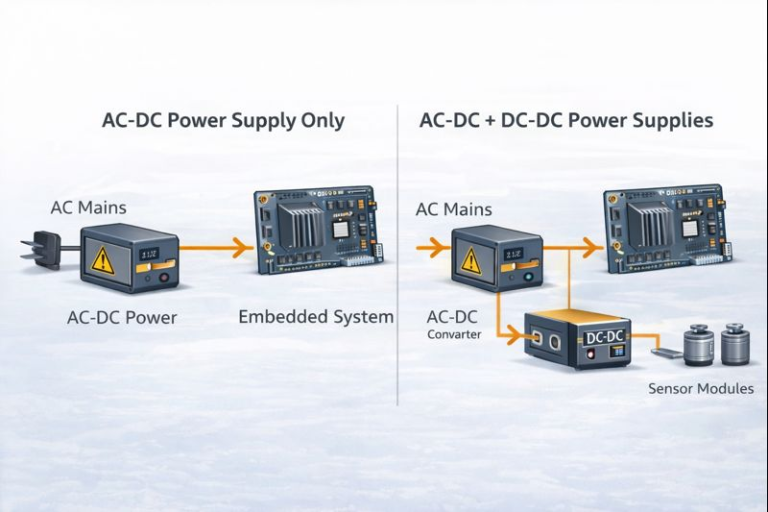
However, in real-world systems, these two are not alternatives.
They are typically used together, at different layers of the power architecture.
A common misconception among less-experienced designers is treating AC-DC and DC-DC as interchangeable options. In practice, they serve fundamentally different roles.
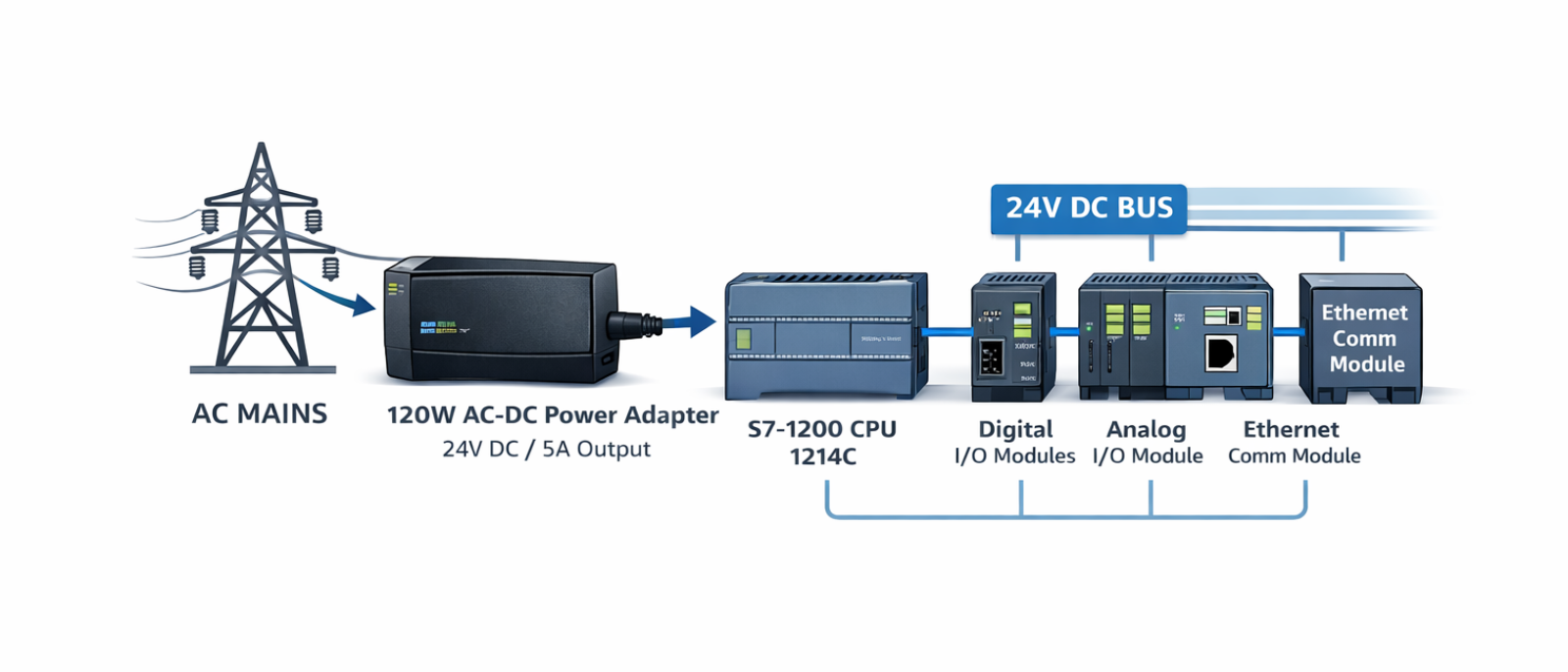
AC-DC power supplies convert mains AC voltage into stable DC output for electronic systems.
In many embedded devices, engineers use an external AC-DC power adapter to provide safe and regulated DC input.
3. Typical Power Architectures in Embedded and Industrial Systems
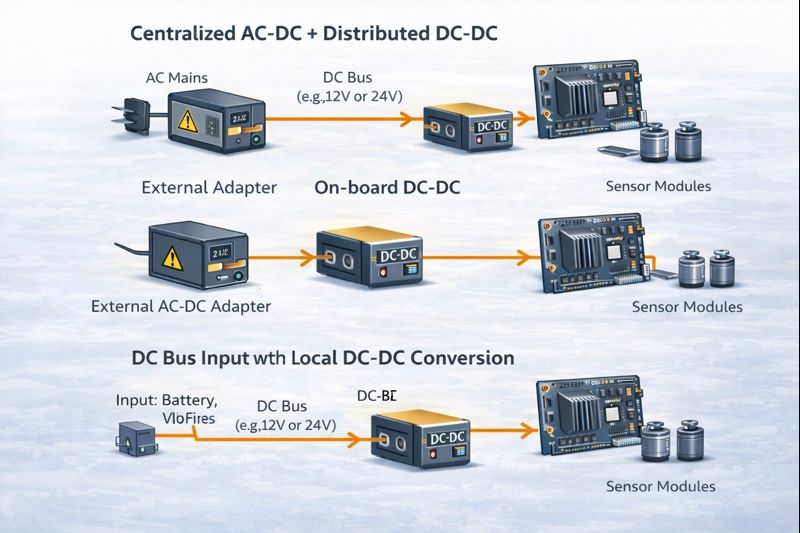
Most reliable systems follow one of these architectures:
Centralized AC-DC + Distributed DC-DC
- One AC-DC power supply generates a main DC bus (e.g., 24V or 12V)
- Multiple DC-DC converters regulate voltage locally for processors, sensors, and interfaces
This approach is common in:
- Industrial controllers
- Automation panels
- Communication equipment
External AC-DC Adapter + On-board DC-DC
- An external adapter handles mains isolation and safety
- DC-DC converters on the PCB generate required rails
Typical for:
- Embedded devices
- Medical and test equipment
- Compact systems with limited internal space
DC Bus Input + Local DC-DC Conversion
- System is powered by an existing DC source (battery, vehicle bus, or centralized supply)
- Only DC-DC converters are required internally
Used in:
- Battery-powered systems
- Telecom and transportation equipment
Understanding which architecture applies to your system is the foundation of a correct AC-DC vs DC-DC decision.
4. Key Factors When Choosing Between AC-DC and DC-DC
4.1 Input Power Source
If your system connects directly to mains power, AC-DC conversion is mandatory.
DC-DC converters alone cannot provide isolation or meet safety requirements for mains-connected equipment.
If the input is already DC, then DC-DC becomes the primary choice.
4.2 Safety and Isolation Requirements
AC-DC power supplies provide reinforced or basic isolation between mains and low-voltage circuits.
This is critical for:
- Industrial safety compliance
- Medical and laboratory equipment
- User-accessible electronics
Using a DC-DC converter where isolation is required is one of the most common—and dangerous—design mistakes.
4.3 Power Level and Load Distribution
AC-DC power supplies are typically used for:
- Tens to hundreds of watts
- Supplying a shared DC rail
DC-DC converters excel at:
- Point-of-load regulation
- Handling fast transient loads
- Improving local voltage stability
High-performance systems often rely on DC-DC converters even when a capable AC-DC supply is already present.
4.4 Thermal and Mechanical Constraints
AC-DC power supplies tend to:
- Generate more heat
- Require airflow or heat sinking
- Occupy more volume
DC-DC converters:
- Can be placed near loads
- Reduce copper losses on the PCB
- Improve thermal distribution across the system
Enclosed industrial systems often depend on DC-DC conversion to avoid localized hot spots.
Engineers must carefully match voltage and current requirements when integrating DC-DC converters into embedded systems.
Our Power Adapter Selection Guide explains how to choose the correct voltage, current, and connector configuration.
4.5 EMC and Noise Considerations
AC-DC supplies deal with:
- Conducted emissions on the mains
- High-energy switching noise
DC-DC converters introduce:
- High-frequency noise close to sensitive circuits
The correct choice—and placement—of each stage has a direct impact on EMC compliance and signal integrity.
5. Common Design Mistakes
Engineers frequently encounter issues due to early architectural decisions:
- Using DC-DC converters without proper isolation in mains-powered systems
- Oversizing AC-DC supplies while ignoring point-of-load regulation
- Assuming efficiency alone determines system reliability
- Underestimating startup current and transient load behavior
Most of these issues originate from treating AC-DC vs DC-DC as a component choice instead of a system-level decision.
6. How This Decision Affects the Rest of the Power Design
The AC-DC vs DC-DC choice directly influences:
- Power margin calculations
- Thermal management strategies
- EMC filtering and grounding
- Redundant and backup power architectures
In fact, nearly every downstream power design decision depends on this initial architectural choice.
This is why experienced designers address AC-DC vs DC-DC before selecting specific models or ratings.
7. Practical Recommendations
There is no universal “correct” choice between AC-DC and DC-DC power supplies.
Instead:
- Use AC-DC to handle mains input, safety isolation, and bulk power conversion.
- Use DC-DC for voltage regulation close to the load, thermal optimization, and performance stability.
- Treat power design as a layered architecture, not a single component decision.
A reliable embedded or industrial power system is built by combining both appropriately—not by choosing one over the other.
When designing your system, it’s important to calculate the power margin for your device. Read our detailed guide.